There is a slyness with which India Inc and their pubic relations (PR) companies treat the media. Partly, of course, it is the media's self-imposed cowardliness but it also due to the sophistication that the public relations companies (or in some cased the companies do it directly without hiring a public relations firm) deploy to discourage/intimidate/fool the editors and journalists that dare to ask even basic tough questions about their client-companies.
As a journalist, I have seen how some PR companies directly deal with the Editor-in-chief (or other senior editors) of a publication or a news channel and try to manipulate them if they perceive a junior-level editor/reporter probing the affairs of their clients a little deeper (such a journalist, in my view, would only be carrying out his/her journalistic duties more diligently).
The PR companies that try to aggressively wield a lot of influence on the top media editors include Genesis Burson-Marsteller, Vaishnavi PR, Perfect Relations and 2-3 more.
The media dare not even write about their PR companies as a part of the regular coverage of the role of all kinds of business entities in the economy and industry. But in June this year Tehelka magazine dared and wrote a story on them (you can read it here). It was a welcome torchlight on an evasive bunch of people although I still felt the story was soft.
There is a lot more to say about the techniques used by the PR companies that would do a Goebbels proud. The readers/viewers of Indian media do not adequately know the kind of insights/news/analysis they are missing out on due to such Goebbels'.
September 29, 2008

September 24, 2008
life in financial markets&general: unhealthy judiciary-corporate nexus
There is a deadly and unhealthy nexus between industry and judiciary that is among other few aspects that makes a mockery of the claims by India that it is the largest democracy of the world. There are two things going on, with regard to the rulings by the judges of various High Courts in the country and the judges of the Supreme Court of India, since a few years now and these have got accentuated in recent weeks and months.
1) When they have passed judgements in cases filed by citizens/villagers groups or NGOs against land grab (whether for SEZs or any other so-called 'development' (that, according to me, is a myth perpetuated by industry, blindly believed by urban/semi-urban consumers and aggressively supported by all the top media editors in India), protection of property rights and equal and fair treatment of their human rights they have ruled against. Two examples are one recent (early September 2008) judgement by Supreme Court judges dismissing a petition that strove to stop the illegal grab of farmers' land by Andhra Pradesh state government for a supposedly 'infrastructure' project (see here), and the 8 year old judgement by the Supreme Court on the Narmada dam issue when the Narmada Bachao Andolan filed a petition (in that ruling, two Supreme Court openly pimped for government claims and completely overlooked the major problems and development&environment rules violations that were going on).
2) On the other hand, when they have decided on cases filed by companies or government bodies, on similar issues or issues connected with property rights of companies and rich landlords, they have ruled in favour of them. Just today there has been one (see here). The companies ridicule NGOs and activist groups for using the courts often but reveal their hypocrisy when they themselves approach the courts to protect their vested business interests. Reliance Industries, for instance, last week filed a petition against a Maharashtra district's (Raigad's) collectors decision to hold a villagers' referendum on the SEZ that Reliance wants to build there. Then, Tata Motors, is asking the Calcutta High Court that details of the pact between the company and the West Bengal government for the Singur car plant not be made public. The judiciary of India protects the property rights of the rich and the industry but denies the same to the poor or not-for-profit NGOs.
Here is something I wrote on the same matter and emailed it to 3-4 newspapers for their 'Letters to Editor' section:
In the last 10 years the Supreme Court (SC) of our country has repeatedly handed out shocking treatment to the powerless rural citizens of India as well as to our country's voiceless ecology. In the name of large or small development projects the SC judges have denied the rural people their right to property and cared two hoots about preserving the fragile ecological balance of our country's rivers, mountains, seas, rivers and forests.
The latest case of two Supreme Court judges dismissing a petition that strove to stop the illegal grab of farmers' land by Andhra Pradesh state government for an infrastructure project is yet another nail in Indian democracy's coffin. To justify such verdicts, the central government of India, state governments, the Supreme Court and the various High Courts, have often resorted to the myth of employment generation.
All these bureaucrats, politicians and judges are either lying or they are ignorant of the vast potential that rural lands have for the people residing there in generating agri-based employment. In fact, about 50 per cent of this potential is already being tapped by local people in the remote lands of India. If the politico, bureaucracy and judiciary can not assist in tapping the remaining 50 per cent potential the least they should do is to keep off from killing the existing 50 per cent tapped potential.
The latest SC judgement resorts to 'public good' argument. According to me, 'public good' is a myth. There is no objective assessment of the benefits and harms/pitfalls in any SEZ or other project. The state and bureaucracy is completely beholden to the industry lobby and oblivious to the repeated concerns expressed by ecologists and civil NGOs. The so-called 'development' benefits are, in my view, far lower than the benefits that would accrue if we were to even just leave the rural people alone and allow them to use their land and resources as per what they think is appropriate. Forcing city-centric development mindset on rural India is criminal.
The time has come for Indian civil groups and affected people to lodge a complaint against the Supreme Court of India in some relevant international courts. The Indian judiciary has lost its credibility.
1) When they have passed judgements in cases filed by citizens/villagers groups or NGOs against land grab (whether for SEZs or any other so-called 'development' (that, according to me, is a myth perpetuated by industry, blindly believed by urban/semi-urban consumers and aggressively supported by all the top media editors in India), protection of property rights and equal and fair treatment of their human rights they have ruled against. Two examples are one recent (early September 2008) judgement by Supreme Court judges dismissing a petition that strove to stop the illegal grab of farmers' land by Andhra Pradesh state government for a supposedly 'infrastructure' project (see here), and the 8 year old judgement by the Supreme Court on the Narmada dam issue when the Narmada Bachao Andolan filed a petition (in that ruling, two Supreme Court openly pimped for government claims and completely overlooked the major problems and development&environment rules violations that were going on).
2) On the other hand, when they have decided on cases filed by companies or government bodies, on similar issues or issues connected with property rights of companies and rich landlords, they have ruled in favour of them. Just today there has been one (see here). The companies ridicule NGOs and activist groups for using the courts often but reveal their hypocrisy when they themselves approach the courts to protect their vested business interests. Reliance Industries, for instance, last week filed a petition against a Maharashtra district's (Raigad's) collectors decision to hold a villagers' referendum on the SEZ that Reliance wants to build there. Then, Tata Motors, is asking the Calcutta High Court that details of the pact between the company and the West Bengal government for the Singur car plant not be made public. The judiciary of India protects the property rights of the rich and the industry but denies the same to the poor or not-for-profit NGOs.
Here is something I wrote on the same matter and emailed it to 3-4 newspapers for their 'Letters to Editor' section:
In the last 10 years the Supreme Court (SC) of our country has repeatedly handed out shocking treatment to the powerless rural citizens of India as well as to our country's voiceless ecology. In the name of large or small development projects the SC judges have denied the rural people their right to property and cared two hoots about preserving the fragile ecological balance of our country's rivers, mountains, seas, rivers and forests.
The latest case of two Supreme Court judges dismissing a petition that strove to stop the illegal grab of farmers' land by Andhra Pradesh state government for an infrastructure project is yet another nail in Indian democracy's coffin. To justify such verdicts, the central government of India, state governments, the Supreme Court and the various High Courts, have often resorted to the myth of employment generation.
All these bureaucrats, politicians and judges are either lying or they are ignorant of the vast potential that rural lands have for the people residing there in generating agri-based employment. In fact, about 50 per cent of this potential is already being tapped by local people in the remote lands of India. If the politico, bureaucracy and judiciary can not assist in tapping the remaining 50 per cent potential the least they should do is to keep off from killing the existing 50 per cent tapped potential.
The latest SC judgement resorts to 'public good' argument. According to me, 'public good' is a myth. There is no objective assessment of the benefits and harms/pitfalls in any SEZ or other project. The state and bureaucracy is completely beholden to the industry lobby and oblivious to the repeated concerns expressed by ecologists and civil NGOs. The so-called 'development' benefits are, in my view, far lower than the benefits that would accrue if we were to even just leave the rural people alone and allow them to use their land and resources as per what they think is appropriate. Forcing city-centric development mindset on rural India is criminal.
The time has come for Indian civil groups and affected people to lodge a complaint against the Supreme Court of India in some relevant international courts. The Indian judiciary has lost its credibility.
September 21, 2008
life in financial markets: lehman brothers in india....
This post has two parts -- first one is about Lehman Brothers' subsidiaries in India and the second one is a follow-up to my my 17 September post 'Life in financial markets: hypocrties' anthem "privatise gains, socialise risks"
1)
Lehman Brothers Holdings Inc, that declared bankruptcy in the US, is the ultimate parent for almost all its eight Indian subsidiaries – Lehman Brothers Securities Pvt. Ltd (LBS), Lehman Brothers Services Pvt. Ltd, Lehman Brothers Financial Services (India) Pvt. Ltd, Lehman Brothers Structured Finance Services Pvt. Ltd, Lehman Brothers Capital Pvt. Ltd, Lehman Brothers Fixed Income Securities Pvt. Ltd, Lehman Brothers Advisers Pvt. Ltd and Lehman Brothers Corporate Services India Pvt. Ltd. Not all these subsidiaries would be operationally active but those that are would now face difficulties in carrying on operations. Their around 3000 employees are in a panic mode with many of them updating their resumes and sending out to othe prospective employers or recruitment consultants/websites.
The one good thing about the US markets that is misearbly lacking in Indian and all other markets is the level of transparency. It is high even though it is not great in the US but in the rest of the markets it ranges from low to very low. Another thing is that man American analysts are refreshingly bold in criticising their governments and regulators for doing regressive things. I have got most of my understanding of why the government bailouts in the US or anywhere is regressive from American analysts and commentators themselves. Here, in India, barring an occasional voice or two, most of the analysts and commentators are cowards and support almost every regressive step that finance minister, Chidambaram, or the commerce minister, Kamal Nath (notorious for his devious obsession in pusing for more and more sops for SEZs) RBI or the Sebi takes with regard to the economy or the financial markets.
Here are some examples of some American analysts/commentatos' telling it like it is:
1) After the nationalisation of Fannie Mae and Freddie Mac, CNBC, on 8 September, quotes an investor and fund manager, Jim Rogers, as saying "... America is more communist thatn China is right now. You can see that this welfare of the rich, it is socialism for the rich... its just bailing out financial institutions... This is madness, this is insanity, they have more than doubled the American national debt in one weekend for a bunch of crooks and incompetents. I'm not quite sure why I or anybody else should be paying for this..."
2) Mike Shedlock, an investment advisor, says openly in his 21 September post that the Bush administration is seeking unreviewable dictatorial power by pressurising Congress to hand over power to him to buy $700 billion worth of in-deep-loss mortgage investments that financial companies are stuck with.
3) The ludicrous ban on short selling by SEC has be ripped apart by many in the US -- Peak Sanity, Peak Sanity--Comments, Short Sellers Targetted, Short Sellers Targetted--Comments, Paulson's Shorting Ban Needs Revisions Already, Paulson's Shorting Ban Needs Revisions Already--Comments. From the comments sections, here are some interesting ones: (a) "... These are supposedly the bureaucrats that champion the wisdom of the free market and the market's ability to correct itself over time. Now they seem drunk with the taxpayers dime rushing from one billions of dollars fix to the next. All this plus two (and possibly more) land wars in Asia financed with borrowed money. It is nuts." (b) "UNBELIEVABLE! I didn't buy a house when I could have because I believed it to be prudent to wait til the market dropped. I didn't get into debt because I knew we were on our way to the greatest credit crisis the world has ever seen. Because I have been prudent and saved my money and waited to short the Sh*t out of this market, I lose and those that were spending like there was no tomorrow, that took out loans bigger than what they could pay, that levered themselves to the skies....they win! This is not a free market and I am fed up with those running the system and this country!" (c) "... Now Paulson and Bush and Bernancke stand before the country and declare they are taking steps to save the country... including unlimited powers for Paulson, and Congress can't wait to say yes...exactly the way the Iraq war was sold. Just freaking say no...is there anyone with an integrity in Congress...we are of course being sold down the river. No pain, no gain. Let the freaking markets work."
1)
Lehman Brothers Holdings Inc, that declared bankruptcy in the US, is the ultimate parent for almost all its eight Indian subsidiaries – Lehman Brothers Securities Pvt. Ltd (LBS), Lehman Brothers Services Pvt. Ltd, Lehman Brothers Financial Services (India) Pvt. Ltd, Lehman Brothers Structured Finance Services Pvt. Ltd, Lehman Brothers Capital Pvt. Ltd, Lehman Brothers Fixed Income Securities Pvt. Ltd, Lehman Brothers Advisers Pvt. Ltd and Lehman Brothers Corporate Services India Pvt. Ltd. Not all these subsidiaries would be operationally active but those that are would now face difficulties in carrying on operations. Their around 3000 employees are in a panic mode with many of them updating their resumes and sending out to othe prospective employers or recruitment consultants/websites.
LBS, that is a member on the NSE and the BSE as well as a Sebi-registered merchant banker, had to face some reaction from the two exchanges on 16 September. The NSE and the BSE stopped it from trading in derivatives and asked it to make pre-trade deliveries or payments for its sales or purchases in the cash market.
Since the brokerage firm did not have outstanding exposure in its position as a broker it went relatively unscathed. But a look at the company's old financial statements for the period from 2005 to March 2007 reveals interesting stuff. LBS had accumulated net losses of about Rs 54 crore against revenues of only about Rs 6 crore. Its fully-paid up equity capital as at the end of March 2007 was about Rs 222 crore (of 222 million shares of Rs 10 each) which was jacked up to about Rs 786 crore (786 million shares of Rs 10 each) by the end of February 2008 through a capital infusion by Singapore-based Lehman Brothers Investments PTE Ltd. This was done across five instalments – 58 million shares on
The one good thing about the US markets that is misearbly lacking in Indian and all other markets is the level of transparency. It is high even though it is not great in the US but in the rest of the markets it ranges from low to very low. Another thing is that man American analysts are refreshingly bold in criticising their governments and regulators for doing regressive things. I have got most of my understanding of why the government bailouts in the US or anywhere is regressive from American analysts and commentators themselves. Here, in India, barring an occasional voice or two, most of the analysts and commentators are cowards and support almost every regressive step that finance minister, Chidambaram, or the commerce minister, Kamal Nath (notorious for his devious obsession in pusing for more and more sops for SEZs) RBI or the Sebi takes with regard to the economy or the financial markets.
Here are some examples of some American analysts/commentatos' telling it like it is:
1) After the nationalisation of Fannie Mae and Freddie Mac, CNBC, on 8 September, quotes an investor and fund manager, Jim Rogers, as saying "... America is more communist thatn China is right now. You can see that this welfare of the rich, it is socialism for the rich... its just bailing out financial institutions... This is madness, this is insanity, they have more than doubled the American national debt in one weekend for a bunch of crooks and incompetents. I'm not quite sure why I or anybody else should be paying for this..."
2) Mike Shedlock, an investment advisor, says openly in his 21 September post that the Bush administration is seeking unreviewable dictatorial power by pressurising Congress to hand over power to him to buy $700 billion worth of in-deep-loss mortgage investments that financial companies are stuck with.
3) The ludicrous ban on short selling by SEC has be ripped apart by many in the US -- Peak Sanity, Peak Sanity--Comments, Short Sellers Targetted, Short Sellers Targetted--Comments, Paulson's Shorting Ban Needs Revisions Already, Paulson's Shorting Ban Needs Revisions Already--Comments. From the comments sections, here are some interesting ones: (a) "... These are supposedly the bureaucrats that champion the wisdom of the free market and the market's ability to correct itself over time. Now they seem drunk with the taxpayers dime rushing from one billions of dollars fix to the next. All this plus two (and possibly more) land wars in Asia financed with borrowed money. It is nuts." (b) "UNBELIEVABLE! I didn't buy a house when I could have because I believed it to be prudent to wait til the market dropped. I didn't get into debt because I knew we were on our way to the greatest credit crisis the world has ever seen. Because I have been prudent and saved my money and waited to short the Sh*t out of this market, I lose and those that were spending like there was no tomorrow, that took out loans bigger than what they could pay, that levered themselves to the skies....they win! This is not a free market and I am fed up with those running the system and this country!" (c) "... Now Paulson and Bush and Bernancke stand before the country and declare they are taking steps to save the country... including unlimited powers for Paulson, and Congress can't wait to say yes...exactly the way the Iraq war was sold. Just freaking say no...is there anyone with an integrity in Congress...we are of course being sold down the river. No pain, no gain. Let the freaking markets work."
September 20, 2008
life in general: a little girl's mesmerising smile
Life on the city's streets for those who have no choice but to make them their homes can hardly be considered as ideal. I traverse Bombay's streets by foot a lot and I get to encounter these homeless people who have made the streets their homes. Rarely do I fail to experience a kind of distressing feeling when I observe them at close quarters.
So was it today (actually yesterday, Friday, as I am writing this at 0114 hours of Saturday) but with a difference. It was about 2.30 pm. I was in Nariman Point (in south Bombay) on work and was walking by the road outside NCPA when I saw a little girl who must be about 3 years old standing by a streetside railing. Besides her was her little brother who must be about one and a half years. They were alone, their parents and others from their group must have been a bit away from that spot.
Anyway, I had to cross the road at the spot where they were standing. It is not unusual for me to want to strike a conversation with little children and as I was waiting to cross the road (on most Bombay roads the traffic is so heavy that you have to wait for anywhere between 15 seconds to 150 seconds to cross them) I watched the little girl closely. She noticed me watching her and looked at me.
I smiled at her and asked her what her name was. She smiled back and said 'Laxmi'. I stood there mesmerised. Such was the charm in her smile! I smiled again at her and by now her little brother was blabbering something at me. My attention shifted to him for a while. My heart went out for that little girl and I felt a tinge of pain for this lovely little girl who was smiling at a stranger. They were not even asking for money as is the case with many.
I told them 'bye' in English and the little girl just smiled again. Her little brother actually caught the word and muttered 'bye' to me! I crossed the road and on reaching the other side I turned back to look at the little girl. She was watching me. I waved a 'goodbye' to her. She gave me that mesmerising smile yet again and waved back.
This is not the first time I have got a chat going with street children but there was something about this little angel, Laxmi, that makes me go melancholic when I think of her. I don't know if I will get a chance to see her again. I so much wanted to chat with her more but I have to be conscious of the fact that society gets very suspicious when an adult male stranger talks to little girls who are alone and so I do not stretch the chat to beyond a minute or so lest it get interpreted wrongly by others around.
May our universal energy shower its brightest blessings on this little angel!
Let me share something personal and very close to my heart. I try to limit the number of my desires but there is one that has persisted for a long long time. It is my desire to have a daughter on whom I can shower lots & lots of love! Though I was married twice (the last one broke up 8 years back) there was no child in either (both lasted only for 18 months each). In fact, when things were going very awry in my first marriage (1994-95) and my wife and I were trying to patch up for I used to tell my wife that we should have a daughter. Sadly, that was not to be as we broke up a month later. I continue to await a potential future wherein a little girl holds my hand with her tiny fingers as I am walking with her in a nature trail and exclaims excitedly "Daddy, look! A golden butterfly!"
So was it today (actually yesterday, Friday, as I am writing this at 0114 hours of Saturday) but with a difference. It was about 2.30 pm. I was in Nariman Point (in south Bombay) on work and was walking by the road outside NCPA when I saw a little girl who must be about 3 years old standing by a streetside railing. Besides her was her little brother who must be about one and a half years. They were alone, their parents and others from their group must have been a bit away from that spot.
Anyway, I had to cross the road at the spot where they were standing. It is not unusual for me to want to strike a conversation with little children and as I was waiting to cross the road (on most Bombay roads the traffic is so heavy that you have to wait for anywhere between 15 seconds to 150 seconds to cross them) I watched the little girl closely. She noticed me watching her and looked at me.
I smiled at her and asked her what her name was. She smiled back and said 'Laxmi'. I stood there mesmerised. Such was the charm in her smile! I smiled again at her and by now her little brother was blabbering something at me. My attention shifted to him for a while. My heart went out for that little girl and I felt a tinge of pain for this lovely little girl who was smiling at a stranger. They were not even asking for money as is the case with many.
I told them 'bye' in English and the little girl just smiled again. Her little brother actually caught the word and muttered 'bye' to me! I crossed the road and on reaching the other side I turned back to look at the little girl. She was watching me. I waved a 'goodbye' to her. She gave me that mesmerising smile yet again and waved back.
This is not the first time I have got a chat going with street children but there was something about this little angel, Laxmi, that makes me go melancholic when I think of her. I don't know if I will get a chance to see her again. I so much wanted to chat with her more but I have to be conscious of the fact that society gets very suspicious when an adult male stranger talks to little girls who are alone and so I do not stretch the chat to beyond a minute or so lest it get interpreted wrongly by others around.
May our universal energy shower its brightest blessings on this little angel!
Let me share something personal and very close to my heart. I try to limit the number of my desires but there is one that has persisted for a long long time. It is my desire to have a daughter on whom I can shower lots & lots of love! Though I was married twice (the last one broke up 8 years back) there was no child in either (both lasted only for 18 months each). In fact, when things were going very awry in my first marriage (1994-95) and my wife and I were trying to patch up for I used to tell my wife that we should have a daughter. Sadly, that was not to be as we broke up a month later. I continue to await a potential future wherein a little girl holds my hand with her tiny fingers as I am walking with her in a nature trail and exclaims excitedly "Daddy, look! A golden butterfly!"
September 17, 2008
life in financial markets: hypocrites' anthem: "privatise gains, socialise risks"
It does not come as a surprise to me -- the hypocrisies of soon-to-be-nuclear-superpower India's so-called capitalists. The last week-end's death of Lehman Brothers and the takeover of a in-great-distress Merrill Lynch, and the the bullying cry for help to the government by AIG (that the Fed has now succumbed to) has once again exposed the hypocrisies of the top-level executives in the financial and corporate sector.
The Indian media has been seeking views from Indian Inc and Indian banking & financial sector about the implications of the global financial crisis on India and generally. As usual, a majority of those who give their views want the US government to bail out the distressed AIG like it did with Fannie Mae and Freddie Mac recently.
I can give two examples from what I remember watching on business news channels the last 3 days. Goverment bailouts of private organisations when they go into financial distrees was rigorously defended by Anil Ambani-owned Reliance Money's CEO Sudip Bandyopadhyay and similarly, though not rigorously, by State Bank of India's chairman, O.P. Bhatt.
Companies like AIG will never price their products and services cheap to their customers (for instance, when I took out my pure-term life insurance policy 3-4 years i was checking out the pure-term policies of all insurance companies and found that Tata-AIG's one was the most expensive... i finally went for HDFC Standard Life's offering). It is ludicrous, therefore, for them to expect themselves to be treated by kid gloves (= bail out) by public taxpayers' money.
Some good reading material can be found at recent blog posts at globaleconomicanalysis.blogspot.com.
Meanwhile, the hypocritical Indian-&-international capitalists can continue to loudly sing their anthem "Privatise gains, socialise risks."
this below part of the post was added on 21 Sep:
The one good thing about the US markets that is misearbly lacking in Indian and all other markets is the level of transparency. It is high even though it is not great in the US but in the rest of the markets it ranges from low to very low. Another thing is that many American analysts are refreshingly bold in criticising their governments and regulators for doing regressive things. I have got most of my understanding of why the government bailouts in the US or anywhere is regressive from American analysts and commentators themselves. Here, in India, barring an occasional voice or two, most of the analysts and commentators are cowards and support almost every regressive step that finance minister, Chidambaram, or the commerce minister, Kamal Nath (notorious for his devious obsession in pusing for more and more sops for SEZs) RBI or the Sebi takes with regard to the economy or the financial markets.
Here are some examples of some American analysts/commentatos' telling it like it is:
1) After the nationalisation of Fannie Mae and Freddie Mac, CNBC, on 8 September, quotes an investor and former partner to George Soros in Quantum, Jim Rogers, as saying "... America is more communist thatn China is right now. You can see that this welfare of the rich, it is socialism for the rich... its just bailing out financial institutions... This is madness, this is insanity, they have more than doubled the American national debt in one weekend for a bunch of crooks and incompetents. I'm not quite sure why I or anybody else should be paying for this..."
2) Mike Shedlock, an investment advisor, says openly in his 21 September post that the Bush administration is seeking unreviewable dictatorial power by pressurising Congress to hand over power to him to buy $700 billion worth of in-deep-loss mortgage investments that financial companies are stuck with.
3) The ludicrous ban on short selling by SEC has be ripped apart by many in the US -- Peak Insanity, Peak Insanity--Comments, Short Sellers Targetted, Short Sellers Targetted--Comments, Paulson's Shorting Ban Needs Revisions Already, Paulson's Shorting Ban Needs Revisions Already--Comments. From the comments sections, here are some interesting ones: (a) "... These are supposedly the bureaucrats that champion the wisdom of the free market and the market's ability to correct itself over time. Now they seem drunk with the taxpayers dime rushing from one billions of dollars fix to the next. All this plus two (and possibly more) land wars in Asia financed with borrowed money. It is nuts." (b) "UNBELIEVABLE! I didn't buy a house when I could have because I believed it to be prudent to wait til the market dropped. I didn't get into debt because I knew we were on our way to the greatest credit crisis the world has ever seen. Because I have been prudent and saved my money and waited to short the Sh*t out of this market, I lose and those that were spending like there was no tomorrow, that took out loans bigger than what they could pay, that levered themselves to the skies....they win! This is not a free market and I am fed up with those running the system and this country!" (c) "... Now Paulson and Bush and Bernancke stand before the country and declare they are taking steps to save the country... including unlimited powers for Paulson, and Congress can't wait to say yes...exactly the way the Iraq war was sold. Just freaking say no...is there anyone with an integrity in Congress...we are of course being sold down the river. No pain, no gain. Let the freaking markets work."
The Indian media has been seeking views from Indian Inc and Indian banking & financial sector about the implications of the global financial crisis on India and generally. As usual, a majority of those who give their views want the US government to bail out the distressed AIG like it did with Fannie Mae and Freddie Mac recently.
I can give two examples from what I remember watching on business news channels the last 3 days. Goverment bailouts of private organisations when they go into financial distrees was rigorously defended by Anil Ambani-owned Reliance Money's CEO Sudip Bandyopadhyay and similarly, though not rigorously, by State Bank of India's chairman, O.P. Bhatt.
Companies like AIG will never price their products and services cheap to their customers (for instance, when I took out my pure-term life insurance policy 3-4 years i was checking out the pure-term policies of all insurance companies and found that Tata-AIG's one was the most expensive... i finally went for HDFC Standard Life's offering). It is ludicrous, therefore, for them to expect themselves to be treated by kid gloves (= bail out) by public taxpayers' money.
Some good reading material can be found at recent blog posts at globaleconomicanalysis.blogspot.com.
Meanwhile, the hypocritical Indian-&-international capitalists can continue to loudly sing their anthem "Privatise gains, socialise risks."
this below part of the post was added on 21 Sep:
The one good thing about the US markets that is misearbly lacking in Indian and all other markets is the level of transparency. It is high even though it is not great in the US but in the rest of the markets it ranges from low to very low. Another thing is that many American analysts are refreshingly bold in criticising their governments and regulators for doing regressive things. I have got most of my understanding of why the government bailouts in the US or anywhere is regressive from American analysts and commentators themselves. Here, in India, barring an occasional voice or two, most of the analysts and commentators are cowards and support almost every regressive step that finance minister, Chidambaram, or the commerce minister, Kamal Nath (notorious for his devious obsession in pusing for more and more sops for SEZs) RBI or the Sebi takes with regard to the economy or the financial markets.
Here are some examples of some American analysts/commentatos' telling it like it is:
1) After the nationalisation of Fannie Mae and Freddie Mac, CNBC, on 8 September, quotes an investor and former partner to George Soros in Quantum, Jim Rogers, as saying "... America is more communist thatn China is right now. You can see that this welfare of the rich, it is socialism for the rich... its just bailing out financial institutions... This is madness, this is insanity, they have more than doubled the American national debt in one weekend for a bunch of crooks and incompetents. I'm not quite sure why I or anybody else should be paying for this..."
2) Mike Shedlock, an investment advisor, says openly in his 21 September post that the Bush administration is seeking unreviewable dictatorial power by pressurising Congress to hand over power to him to buy $700 billion worth of in-deep-loss mortgage investments that financial companies are stuck with.
3) The ludicrous ban on short selling by SEC has be ripped apart by many in the US -- Peak Insanity, Peak Insanity--Comments, Short Sellers Targetted, Short Sellers Targetted--Comments, Paulson's Shorting Ban Needs Revisions Already, Paulson's Shorting Ban Needs Revisions Already--Comments. From the comments sections, here are some interesting ones: (a) "... These are supposedly the bureaucrats that champion the wisdom of the free market and the market's ability to correct itself over time. Now they seem drunk with the taxpayers dime rushing from one billions of dollars fix to the next. All this plus two (and possibly more) land wars in Asia financed with borrowed money. It is nuts." (b) "UNBELIEVABLE! I didn't buy a house when I could have because I believed it to be prudent to wait til the market dropped. I didn't get into debt because I knew we were on our way to the greatest credit crisis the world has ever seen. Because I have been prudent and saved my money and waited to short the Sh*t out of this market, I lose and those that were spending like there was no tomorrow, that took out loans bigger than what they could pay, that levered themselves to the skies....they win! This is not a free market and I am fed up with those running the system and this country!" (c) "... Now Paulson and Bush and Bernancke stand before the country and declare they are taking steps to save the country... including unlimited powers for Paulson, and Congress can't wait to say yes...exactly the way the Iraq war was sold. Just freaking say no...is there anyone with an integrity in Congress...we are of course being sold down the river. No pain, no gain. Let the freaking markets work."
September 14, 2008
life in general: tragic bomb explosions in delhi
Another tragic incident. Around 30 were killed and over 100 were injured when 5 bombs exploded in different parts of Delhi yesterday (13 Sep '08). One prays for the peace of the souls of those who were killed in this terrorist act and prays for the well-being of those injured.
The media is full of news reports (read here, here and here) of an email purported to have been sent by a Muslim group that calls its Indian Mujahideen.
I am getting an uncomfortable feeling that a dangerous game is being played out in the way what the media is being fed from the police and through emails (that anyone can create, send and use material available from public, private or police sources). The impressions about the perpetrators of the bomb blasts that is sought to be created could very easily be misleading. I wouldn't rule out the involvement of non-Muslim extremist groups in yesterday's incident, although I wouldn't put it beyond the Muslim extremist groups either.
Only a neutral investigation will bring out the real truth. The chances of that happening are however not bright.
The media is full of news reports (read here, here and here) of an email purported to have been sent by a Muslim group that calls its Indian Mujahideen.
I am getting an uncomfortable feeling that a dangerous game is being played out in the way what the media is being fed from the police and through emails (that anyone can create, send and use material available from public, private or police sources). The impressions about the perpetrators of the bomb blasts that is sought to be created could very easily be misleading. I wouldn't rule out the involvement of non-Muslim extremist groups in yesterday's incident, although I wouldn't put it beyond the Muslim extremist groups either.
Only a neutral investigation will bring out the real truth. The chances of that happening are however not bright.
September 13, 2008
life in general&journalism: music & my friend clifford!
I was going through some old CDs, that were catching dust in the shelves in my house, when I discovered one that had my handwritten title on it 'Mixed English Oldies - MP3'. It instantly reminded of my friend Clifford Alvares who was my colleague when I worked for Outlook Money magazine. He now works for a business magazine that is a rival and competitor to the one I work for.
Clifford is a true music lover and a collector of gems in western music. Through him, I got to listen to an astounding array of old songs and music of groups and musicians that I would otherwise never had a chance to listen to. He would get MP3 songs from god knows where and play it on his computer in office. My work seat was near his and thats how I got to hear all the songs he played. I used to like roughly 6 out of every 10 songs he played.
And then I would pester him no end to allow me to copy many of these songs from his computer to my own CDs. The CD that I discovered from my dusty shelf today was one such. I loaded this CD on to my notebook and copied the ones I liked on to my notebook.
Cliffie boy! If you read this blog post please accept my gratitude. We may have had our occasional dog fight in the office but the positive energy of lovely music eventually sorted everything out!
Here is a select list of the oldies (in no particular order) that I had the pleasure of listening to from the above CD:
Beautiful Brown Eyes - Clooney, Rosemary & Mitch Miller
A Bushel & A Peck - Doris Day
When Johnny Comes Marching Home - Mitch Miller
Pledging My Love - Johnny Ace
Tic Tac Toe - Jimmy Osmond
Keep On Smiling - Engelbert Humperdinck
House of the Rising Sun - Joan Baez
Till All the Rivers Run Dry - Don Williams
For All We Know - The Carpenters
Just When I Needed You - Barbara Jones
Only Love Would Know - Gordon Lightfoot
I Believe - Frankie Laine
If I Needed You - Emmy Lou Harris & Don Williams
One Fine Day - The Carpenters
Eventide - The Carpenters
Aurora - The Carpenters
Sing - The Carpenters
Mo' Better Blues - Branford Marsalis Quartet
Ghost Riders In the Sky - Frankie Laine
Clifford is a true music lover and a collector of gems in western music. Through him, I got to listen to an astounding array of old songs and music of groups and musicians that I would otherwise never had a chance to listen to. He would get MP3 songs from god knows where and play it on his computer in office. My work seat was near his and thats how I got to hear all the songs he played. I used to like roughly 6 out of every 10 songs he played.
And then I would pester him no end to allow me to copy many of these songs from his computer to my own CDs. The CD that I discovered from my dusty shelf today was one such. I loaded this CD on to my notebook and copied the ones I liked on to my notebook.
Cliffie boy! If you read this blog post please accept my gratitude. We may have had our occasional dog fight in the office but the positive energy of lovely music eventually sorted everything out!
Here is a select list of the oldies (in no particular order) that I had the pleasure of listening to from the above CD:
Beautiful Brown Eyes - Clooney, Rosemary & Mitch Miller
A Bushel & A Peck - Doris Day
When Johnny Comes Marching Home - Mitch Miller
Pledging My Love - Johnny Ace
Tic Tac Toe - Jimmy Osmond
Keep On Smiling - Engelbert Humperdinck
House of the Rising Sun - Joan Baez
Till All the Rivers Run Dry - Don Williams
For All We Know - The Carpenters
Just When I Needed You - Barbara Jones
Only Love Would Know - Gordon Lightfoot
I Believe - Frankie Laine
If I Needed You - Emmy Lou Harris & Don Williams
One Fine Day - The Carpenters
Eventide - The Carpenters
Aurora - The Carpenters
Sing - The Carpenters
Mo' Better Blues - Branford Marsalis Quartet
Ghost Riders In the Sky - Frankie Laine
September 11, 2008
life in general: the vagina monologues
The Indian version of Eva Ensler's 'The Vagina Monologues' is a remarkable play enacted for the theatre, and it has been a great hit in Bombay and other parts of India for a few years now.

Today evening, or rather yesterday to be technically correct (as it 25 minutes past midnight as I write this), I watched it for the first time. It was the 197th performance of the play in India. I quite liked the play. It was both, serious and fun. The play is about women empowerment issues and as a man I have always encouraged this kind of thing. The five female performers -- Jayati Bhatia, Mahabanoo Mody-Kotwal, Sonali Sachdev, Avantika Akerkar and Dolly Thakore -- acted wonderfully in their portrayals of various kinds of women in the script.
To know more about the stories told in the play click on the two links given above and to know about the the play's international versions click here.
The pic alongside was clicked by me at the play immediately after it got over and the five women were conferring with each other in a huddle for a while.

Today evening, or rather yesterday to be technically correct (as it 25 minutes past midnight as I write this), I watched it for the first time. It was the 197th performance of the play in India. I quite liked the play. It was both, serious and fun. The play is about women empowerment issues and as a man I have always encouraged this kind of thing. The five female performers -- Jayati Bhatia, Mahabanoo Mody-Kotwal, Sonali Sachdev, Avantika Akerkar and Dolly Thakore -- acted wonderfully in their portrayals of various kinds of women in the script.
To know more about the stories told in the play click on the two links given above and to know about the the play's international versions click here.
The pic alongside was clicked by me at the play immediately after it got over and the five women were conferring with each other in a huddle for a while.
September 07, 2008
life in general: update on the bihar floods situation
Three days back I had posted on the dire situation in Bihar state due to unprecedented floods. 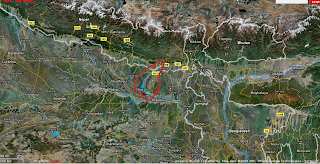
(the image to the right has been taken by me from wikimapia... the red circle was added by me to highlight the affected areas in bihar...click on the image to see it enlarged)
Below is an from-the-ground update:
From: Date: 2008/9/6

(the image to the right has been taken by me from wikimapia... the red circle was added by me to highlight the affected areas in bihar...click on the image to see it enlarged)
Below is an from-the-ground update:
From:
Subject: [nbapresslist] UPDATE ON THE FLOOD SITUATION IN BIHAR
To: nbapresslist@lists.riseup.net
6 September 2008UPDATE ON THE FLOOD SITUATION IN BIHAR
Everyone has been hoping that the rescue operations in the calamity-affected areas of Bihar would get over, if not after 5 or 10 days, at least after 15 days. However, till today even after 12 days, there are thousands of families who seem to have been ensnared by the Koshi's waters – either on marooned chunks of land in the affected villages or on the rooftops on some lone structure or on the embankments, rail lines, roads nearby.
With the army boats coming in and the country boats being contracted by the Government with the boatmen, it is being claimed that enough boats have now arrived and the rescue operations are in full control. But, in reality, though the army and navy camps are in place and there is an improvement in the rescue operations, the task is far from over.
Yesterday we reached Beldaur in Madhipura districts, where the army camps appeared to be active. Shockingly, the people coming out of the boats are screaming and complaining that their kith and kin in the villages who are sick and starving, should be rescued immediately. Even as the 'operations' continue, the Army Commander did not even have a list of the villages along with the number of families and people to be rescued. How can this situation be acceptable? It is simply unacceptable that hordes of people have been waiting for not one or two, but for more than 15 full days. We also gathered that diseases, particularly diarrhoea and skin ailments are breaking out in the villages and camps. Thousands of cattle, unattended, lay scattered all over the relief camps and are also visible in large numbers on the roads that lead from the flooded villages to the relief camps. Even those people, who at times thought of staying put in the villages, had to take a decision and leave the villages, as the meager food grains, which was until now saved from submergence, got exhausted. The shrieks and cries of the people are simply unbearable.
Our intervention could only help convince the Army Officials, to send the first boat to the villages where there were problems and the rescue of people began only after they were forced to wait for days and weeks. Just as we reached, there were two deaths reported, within a span of half an hour over the wireless. One was in Ratanpatti, the village visited by us, where we witnessed the horrifying situation of hundreds of women, children, elders and men, waiting for hours together to get space for only 8-10 persons on the boat, to cross just a few meters. Thee boats reached after 15 full days of awaiting and hunger.
It seems as if death has become a part of life in these areas in Bihar, its shadows hovering on the waters of Koshi, sinking the humans and cattle alike.
The Government has declared a figure of 'twenty two', as the official number of dead, over the last few days, but none of the villagers, who have witnessed the dance of death of Koshi would buy these grossly underestimated statistics.
All this and much more has deeply shocked and shattered all of us, when we reached the spot at Pratapganj in Supoul. The moment we started enquiring with the people who had come out, all of whom were visibly looking crestfallen, there were no answers to our questions initially, but the people slowly opened up, speaking hard and narrating poignant stories of pain and deprivation.
People of Dharampur had started walking yesterday and reached today. Those from a comparatively nearby village, Lalitgram, also had to walk for not less than 6-7 hours in the flooded waters of Koshi. "Seventeen people died in my village", said Harish Chandra Bushkuriya of Pariyahi village and many are critically sick. He was desperate that at least one boat be sent to his village the same day, but by the time we could speak with the army chief there, Pradeep Sharma in command, they had left. No doubt, the boat was stocked with food materials, but there was no guarantee of it going back to Pariyahi. Such major news, the Army officials did not even disclose, based on the operations of their contacts with the interiors.
Another person from Lalitgram could not wait for a minute and interfered and insisted that he should be heard first. "Three to four deaths a day are occurring every day and where is the administration?", he yelled. He poured out his woes that his community brethren are lying on the river bank with no food, the food packets thrown from the aircrafts, they told us, were mostly spoiled and wasted by the food getting mixed with the soil and at times even hitting people from above. Whatever little remained was consumed, for one half meal a day. This person was none other than the ‘mukhya’ (village chief).
The most poignant incident was narrated by the people of Lalitgram. The army boat crashed into a railway line near a culvert, causing the death of seven persons on the spot, including 4 children and a 21 year old pregnant woman, Saira Khatun. The only person who escaped was her husband who had in fact warned the army officials against going in the fateful direction. “His advice was not only not heeded, but he was in fact abused and beaten up”, his relatives, in utter grief and sorrow narrated the incident. He was however keen to do anything for saving his people from drowning. What was more of a shock and surprise was that the diametrically opposite information about the incident was provided by the Army to the District Collector, that all persons, but one, on board the boat were rescued.
The news of thousands of families having been camping on the Arraha canal was first disbelieved, both by the SDO and the Collector, both of whom we spoke to.
The SDO was present right at the spot, but with no active intervention.
Chattapur, has not less than 17 wards, with the boats finding it difficult to reach out to at least 500 persons still left out and stranded. Mohd. Sadiq who managed to come out is as much concerned about cattle, as human life.
The Government has not and is still not following a simple yet vital practice of interacting effectively with the people who are coming out and reaching out to the people still stranded inside on this basis. This just seems to be missing. All of this requires a simple input with about 20 volunteers and one senior official from the Army for rescue and multiple actions in a quick and better way.
How is it that the Centre and the State governments have not been thinking of joint planning and execution when this has been declared as a national calamity? Why hasn't a dedicated Central team been constituted to over see the entire process? Co-ordinated planning, by mobilizing aircrafts, boats and resources from all over, to the maximum extent necessary could have and still can avert a lot of loss to the life, limb and livelihood. With the boats coming in this late and water receding slowly and some villages being after the culvert, the pace of rescue is not to the required momentum.
We all must keep up the pressure on the Government and ensure that boats from all over are diverted for this purpose. Just as we questioned the State as to why more motor boats were not called in from Mumbai, after days of persuasion and challenge, 24 boats came in with a cadre of 60 personnel. The same could have happened with the Cast Guards or the machine boats available in large numbers at the Howrah port.
We were able to gather more information today as well, with our intervention and the little intervention in the system-building also did have an impact. We worked as a team of volunteers on various tasks, including gathering information on the inside situation.
There has, however, not been much of improvement on the other front. Civil society and NGO camps still do not have food grains, in adequate quantities from the State (FCI).Large organisations seem to be active in relief work only in Supoul, foe whatever reasons. Hand pumps have reached many camps. Though, through our persistent intervention to provide adequate rations, some of the Government camps are now being provided by the same.
Even as relief and aid goes on, there is inept talk from various Govt. and political quarters in favour of construction of the high Dam on Koshi, and arguments to re-construct the broken embankments or even putting forth the dangerous proposal of inter linking of rivers. As against this, civil society must initiate and the state must welcome a healthy public debate on the issue of large dams, embankments and their relative merits and demerits.
We must be able to clearly put forth out perspective of preserving the natural ecosystems and human livelihood by alternative ways of harnessing water, instead of bilaterally favouring mega hydel initiatives despite innumerable past failures, not to speak of the current Koshi barrage debacle.
Let us all synergize our efforts in preserving the rich Koshi ecosystem, with seven rivers upstream and sixty tributaries downstream. This is an opportunity, though at a very high price, for all of us to open-mindedly consider pro-people and pro-environment flood management as the real and sustainable answer. The coming few days, will be a test of the political will and capacity of the Government in reaching out to the million of devastated people.
Medha Patkar Vijay Bhai Pervin Jehangir
09423965153 09431068555 09820636335
Lal Babu, Atik Ahmed, Braj Kisjhore Chaurasia, Babulal,
Sanjay, Lokendra, Rajkumar Sinha, Rajaram
September 05, 2008
life in general: dangerous chemicals in plastic bottles & containers
I present below yet another finding on hazardous-to-health chemicals widely allowed in plastic bottles and containers. This latest study has been done by Canada-based University of Guelph.
Such research and findings emanate mainly from universities in European countries and Canada where the powerful lobbies of chemical and petrochemical companies are not able to penetrate fully enough to kill such research.
In India, the universities' managements (including the chemical department of the so-called great IITs of India) do have have an iota of courage to even initiate such a study. This is mainly because of the massive, sophisticated hooliganism by chemical and petrochemcial companies in India that includes few large corporate groups who are able to kill all initiatives by governments and government bodies to scrutinise their manufacturing process and final products. A case in point is the government-owned National Chemical Laboratory that shamelessly and openly plugs for the chemical and petrochemical companies.
Anyway, here is the News Release statement by the University of Guelph:
http://www.uoguelph.ca/news/2008/09/bpa_impairs_syn_1.html
BPA Impairs Synapses Formation in Brain, New Study Finds
September 03, 2008 - News Release
The controversial chemical Bisphenol A commonly found in hard plastic food and drink containers may impair the brain's ability to learn and remember, according to a groundbreaking study conducted by researchers at the University of Guelph and Yale University. The U of G research has been covered by media outlets across the world, including the Globe and Mail, National Post, Ottawa Citizen, Canadian Press, Washington Post, Times of India, Global television and CTV.
The study reveals that continuous low doses of Bisphenol A (BPA) hinders the formation of synapses in the brain, which allow neurons to communicate with one another and are critical to the way we interpret and remember experiences. "It dramatically impairs the formation of synapses in the regions of the brain important to learning," said biomedical sciences professor Neil MacLusky. "These findings are worrisome because BPA is one of the most widely used chemicals in the world."
BPA is used in plastic water bottles and some baby bottles, dental prostheses and sealants, and in the lining inside of food cans. It has been proven that this chemical can leach from these products and be absorbed through human consumption. Although previous research has been done on the harmful effects of BPA, MacLusky's study, set to be published this week in the Proceedings of the National Academy of Sciences, is the first to mimic continuous environmental exposure levels.
Using the dose level declared safe by the U.S. Environmental Protection Agency for daily consumption by humans, the researchers exposed African green monkeys living on the Island of St. Kitts to BPA for a month. Results showed that even at this low dose, BPA turns off increases in synapses density in the brain normally induced by estrogen, said MacLusky.
"Estrogen is more than just a female reproductive hormone. It enhances the rate at which some types of synapses are formed and is vital in maintaining normal neuronal structure in regions of the brain that control learning, memory and mood state. When we have BPA in our systems, it seriously impairs this process."
Although further research is needed, these results support the possibility that BPA may be involved in human neurological conditions such as Alzheimer's disease, depression and schizophrenia, which all feature aberrant synapse formation and are also sensitive to sex hormone levels, he said. This study was funded by the U.S. National Institutes of Health and the Natural Sciences and Engineering Research Council of Canada.
Contact Prof. Neil MacLusky
Department of Biomedical Science 519-824-4120, Ext. 54700 nmaclusk@uoguelph.ca
For media questions, contact Communications and Public Affairs: Lori Bona Hunt, 519-824-4120, Ext. 53338/l.hunt@exec.uoguelph.ca, or Deirdre Healey, Ext. 56982/d.healey@exec.uoguelph.ca.
Such research and findings emanate mainly from universities in European countries and Canada where the powerful lobbies of chemical and petrochemical companies
 are not able to penetrate fully enough to kill such research.
 In India, the universities' managements (including the chemical department of the so-called great IITs of India) do have have an iota of courage to even initiate such a study. This is mainly because of the massive, sophisticated hooliganism by chemical and petrochemcial companies in India that includes few large corporate groups who are able to kill all initiatives by governments and government bodies to scrutinise their manufacturing process and final products. A case in point is the government-owned National Chemical Laboratory that shamelessly and openly plugs for the chemical and petrochemical companies.
Anyway, here is the News Release statement by the University of Guelph:
http://www.uoguelph.ca/news/2008/09/bpa_impairs_syn_1.html
BPA Impairs Synapses Formation in Brain, New Study Finds
September 03, 2008 - News Release
The controversial chemical Bisphenol A commonly found in hard plastic food and drink containers may impair the brain's ability to learn and remember, according to a groundbreaking study conducted by researchers at the University of Guelph and Yale University. The U of G research has been covered by media outlets across the world, including the Globe and Mail, National Post, Ottawa Citizen, Canadian Press, Washington Post, Times of India, Global television and CTV.
The study reveals that continuous low doses of Bisphenol A (BPA) hinders the formation of synapses in the brain, which allow neurons to communicate with one another and are critical to the way we interpret and remember experiences. "It dramatically impairs the formation of synapses in the regions of the brain important to learning," said biomedical sciences professor Neil MacLusky. "These findings are worrisome because BPA is one of the most widely used chemicals in the world."
BPA is used in plastic water bottles and some baby bottles, dental prostheses and sealants, and in the lining inside of food cans. It has been proven that this chemical can leach from these products and be absorbed through human consumption. Although previous research has been done on the harmful effects of BPA, MacLusky's study, set to be published this week in the Proceedings of the National Academy of Sciences, is the first to mimic continuous environmental exposure levels.
Using the dose level declared safe by the U.S. Environmental Protection Agency for daily consumption by humans, the researchers exposed African green monkeys living on the Island of St. Kitts to BPA for a month. Results showed that even at this low dose, BPA turns off increases in synapses density in the brain normally induced by estrogen, said MacLusky.
"Estrogen is more than just a female reproductive hormone. It enhances the rate at which some types of synapses are formed and is vital in maintaining normal neuronal structure in regions of the brain that control learning, memory and mood state. When we have BPA in our systems, it seriously impairs this process."
Although further research is needed, these results support the possibility that BPA may be involved in human neurological conditions such as Alzheimer's disease, depression and schizophrenia, which all feature aberrant synapse formation and are also sensitive to sex hormone levels, he said. This study was funded by the U.S. National Institutes of Health and the Natural Sciences and Engineering Research Council of Canada.
Contact Prof. Neil MacLusky
Department of Biomedical Science 519-824-4120, Ext. 54700 nmaclusk@uoguelph.ca
For media questions, contact Communications and Public Affairs: Lori Bona Hunt, 519-824-4120, Ext. 53338/l.hunt@exec.uoguelph.ca, or Deirdre Healey, Ext. 56982/d.healey@exec.uoguelph.ca.
Subscribe to:
Posts (Atom)