March 26, 2012

india should de-control diesel and lpg prices

Recently, I contributed an editorial for the newspaper I presently work for. It was on the pressing need of the Indian government to de-control the prices of diesel and domestic LPG. 

Here is what I wrote in the editorial I submitted to the newspaper:


Iron is hot. Strike now.


Wasting time in indecision on de-control of regulated fuel prices is a luxury the country can absolutely not afford to indulge in at the current time. It is not very often that you get a situation where on all fronts, economic, geo-political and national political, the mix of pressure points and lack of it, is just right for the government to de-control all fuel prices.

On the economic front, there are some grave figures of losses to the national ex-chequer that are just screaming for not just attention but also action. The public sector oil marketing companies (OMCs) have suffered from under-recoveries in regulated fuels to the tune of Rs 97,313 crore in the first three quarters of the current financial year.

Diesel under-recoveries were the highest at Rs 56,732 crore, followed by about Rs 20,000 crore each for domestic liquefied petroleum gas (LPG) and kerosene sold through the government's public distribution system. Under-recoveries, caused as they are by the difference between the higher landing cost of the imported fuel paid by OMCs and the lower government-controlled price that the OMCs realise from the dealers. In terms of per unit prices, the under-recoveries, as of mid-March prices, amounted to Rs 13.10 per litre for diesel, Rs 28.67 per litre for kerosene and Rs 439.50 per cyclinder for LPG.

The higher the international prices of crude oil and natural gas go the higher will be the under-recoveries which is very near the point where it will be like the last straw that broke the laden camel's back. The poor fiscal health of the economy makes it much worse for continuing with subsidised fuel prices.

The government tinkered with custom duties by reducing it earlier in the current financial year and this has caused a direct loss of Rs 49,000 crore for the whole year. The finance minister was the least ambigous about the harmful effect that a combination of lower tax receipts and higher expenditure (around 60 per cent of under-recoveries are paid for in cash by the government and the remaining borne by the upstream oil companies such as ONGC and GAIL) was having on the fiscal deficit.

Even the price of de-controlled petrol has been indirectly kept under check by the government for more than a year now. At current prices, the OMCs are losing Rs 4.12 per litre on petrol which is the difference between price of about Rs 42.54 per litre paid by OMCs to refineries on landed cost basis and the price of Rs 38.42 per litre they are charging to petrol dealers. Excise duties and value added tax are factored in the final retail sale price which is Rs 65.64 in Delhi.
With key state elections of Uttar Pradesh, Punjab, Uttaranchal Pradesh and Goa over last month there remains not much of political brownie points to be scored in keeping fuel prices at low levels. Congress, the largest party in the ruling coalition, has lost heavily in these state elections despite all attempts to dangle lower fuel prices as a carrot to the electorate.

There are two full years remaining before the next general elections and the ruling establishment should worry much less about political future than it does about the future of the country's economy. Internationally, the geo-political situation is on fire with crude oil imports from Iran, the hotspot, not going to be without additional costs attached to it.

In the current financial year, India has met 12 per cent of its crude oil demand from Iran. We import more from Saudi Arabia. The changes that US and European Union sanctions on dealings with Iran will entail on Indian crude oil import is difficult to ascertain precisely but keeping domestic fuel pries is certainly going to make the oil import management far more difficult.

The iron is hot and the government should strike immediately. A petrol price hike alone will not help.

March 22, 2012

life in journalism: when government stiffles coverage

Journalists often face major hurdles in reporting events and happenings and these hurdles are either put by government entities or private entities.


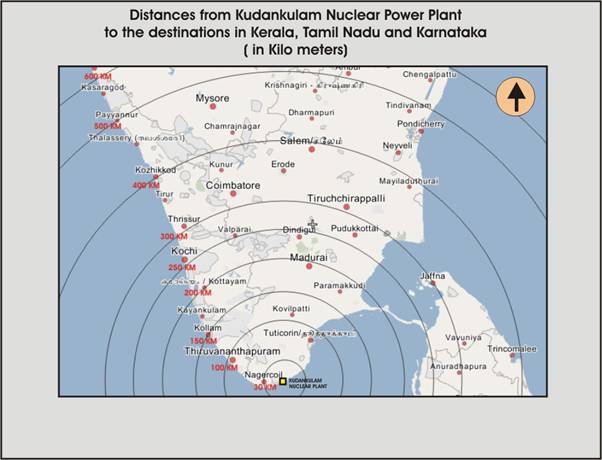
In Tamil Nadu, right now, journalists are facing stiffling restrictions on their attempts to cover the anti-nuclear protests in Idinthakarai, a fishing village, near which a big nuclear plant has been set up.


(the image to the right has been taken from http://www.countercurrents.org/vtp270311.htm)


Here are more details from a report I got in my mailbox:


Reporters Without Borders condemns police obstruction of national print and broadcast media today in Idinthakarai, a fishing village in the southern state of Tamil Nadu, where the authorities are trying to remove entrenched anti-nuclear protesters from their camp beside the Koodankulam nuclear power station.

“It is always disturbing to see the authorities establish a perimeter and deny access to the media, even temporarily, for reasons other than their security,” Reporters Without Borders said. “Installing police barricades and ordering the police not to let the media through is unacceptable. We urge the Tamil Nadu government to modify the orders and allow journalists full access.

“The authorities must not try to use security as pretext for restricting media coverage of a peaceful anti-nuclear demonstration that contributes to the debate on a subject of public interest. A continuing media presence will also help to dispel any concern about the way the police could be treating the demonstrators.”

Police prevented journalists with NDTV, Times Now, Times of India and other national media from entering the fishing village at 7 a.m. today.

After initially saying they had orders from their high command to deny access to all journalists, the police manning the barricades allowed print and video reporters through. But, according to the Madras Press Club, they continued to deny access to TV mobile broadcasting trucks on the grounds that live reports would just exacerbate the situation.

However, when reached by telephone by reporters outside the village, the head of the Tamil Nadu police denied giving any such orders and, according to the latest information obtained by Reporters Without Borders, TV trucks were finally allowed into the village.
The Tamil Nadu government launched its operation against the Koodankulam protesters at the start of the week. Led by the People’s Movement against Nuclear Energy (PMANE), the protesters have been camped for more five months beside the power station, which is supposed to start operating soon.

Demonstrators have been denied access to the protest site, including by sea, since 19 March. They say that journalists have also been denied access since 19 March and that some journalists have been forced to leave the protest site.

Freedom of information has deteriorated significantly of late in India, which was ranked 131st out of 179 countries in the 2011-2012 Reporters Without Borders press freedom index.

March 19, 2012

life in financial markets: tax revenues foregone

Government's tax incentives valued 12 per cent higher this year

Special tax rates, exemptions, deductions, rebates, deferrals and credits is estimated to cost the central government a total of Rs 5,81,872 crore in the current financial year (FY12), 12.5 per cent more than it did in the previous year (FY11). This is revealed in a FC R analysis of the statement of revenue foregone under the central tax system which was released as a part of the budget documents on Friday. The analysis encompasses the tax incentives given in four major revenue heads, personal income tax, corporate income tax, excise duties and customs duties.

The government's statement of revenue foregone, while putting a value to various tax incentives, states this is done "assuming that the underlying tax base would not be affected by removal of such measures. As the behaviour of economic agents, overall economic activity... could change along with the elimination of the specific tax preference, the revenue implications could be different to that extent." 

As per the current year estimates, revenue foregone due to customs duty concessions, including revenue foregone from export promotion schemes other than drawback, has risen the highest, on a year-on-year basis, at 20 per cent to Rs 2,76,093 crore in FY12 from Rs 2,30,131 crore in FY11. Essentially, the revenue foregone in customs duties represents the difference between duty that would have been payable at tariff rates fixed under the Customs Tariff Act, 1975 but for the exemptions given by the central government (using its powers under Customs Act, 1962) and the actual duty paid after the exemptions.

In customs duties, the two major commodity groups, crude oil and mineral oils, and diamond and gold, accounted for the largest portion of revenue foregone. In June 2011, effective basic customs duty on crude petroleum oil was reduced from 5 per cent to nil, that on petrol and diesel was slashed to 2.5 per cent each from 7.5 per cent each. As a result, the customs duty revenue foregone from crude oil is estimated to be Rs 58,190 crore in FY12, 41 per cent more than Rs 41,200 crore in FY11. Customs duty foregone on diamond and gold, is seen to be at Rs 57,073 crore in FY12, 16 per cent higher than it was in previous year.

Revenue foregone due to personal income tax concessions, a large part of which is taken up through deductions allowed under Section 80C of the Income Tax Act, is estimated to be at Rs 42,320 crore in current year, 15 per cent higher than in previous year. Interestingly, tax concessions given to corporate tax payers is estimated to be 11 per cent lower, at Rs 51,292 core, than last year's Rs 57,912 crore.

Cost of tax incentives


The government has put a value to various tax concessions. Here's the latest.

Revenue foregone during:


2011-12* 2010-11 YoY change
Corporate income tax 51292 57912 -11.43
Personal income tax 42320 36826 14.92
Excise 212167 192227 10.37
Customs** 276093 230131 19.97
* estimates


** includes revenue foregone from export promotion schemes other than drawback
Figures in Rs crore

March 16, 2012

life in financial markets: india's tax revenues hit by slack in corporate tax, excise and customs

The current year is turning out be one of the worst growth years in tax revenues for the government of India. The pace at which revenues received by the government in the form of taxes, direct and indirect, have been growing in the current financial year (FY12), is lower than recent years. This is indicated from an analysis of the trend in collections of two major direct tax heads, corporation tax and income tax, and three major indirect tax heads, central excise duties, customs and service tax.


This has caused only 69 per cent of net tax revenues (after assignment to states) estimated at Rs 6,64,457 crore in budget 2011-12 to be reached in the first 10 months of FY12. It falls much behind the 80 per cent of budget estimate of Budget 2010-11.

The analysis of individual tax heads reveals individuals paying income tax and all those paying service tax on services have helped the government fill up its coffers much more than companies which have been faced with lower profit growth resulting into a sluggish growth in paid corporate taxes. Un-exciting rate of growth in sales, also the reason behind sluggish corporate profits, has resulted in only a small growth in excise duties. Customs collection growth too has been affected a little, partly due to imports getting costlier on account of rising global commodity prices.

Low growth in tax revenues
Current year has seen most tax revenues struggle to grow at the same pace as previous years
             YoY Growth rates (%)
-----------------------------------------------------
Tax revenuesFY12*          (Rs crore)  FY12**  FY11   FY10   FY09     FY08
Corporation tax2287505.0421.1114.6810.6233.68
Income tax11435021.1812.6624.773.3136.69
Central excise duties1299266.2229.59-2.11-12.004.94
Customs13621412.0358.18-16.58-4.0720.61
Service tax8256236.9018.79-4.1318.7936.45
* Apr-Jan for corporation tax & income tax & Apr-Feb for excise, customs & service tax
** change from corresponding period of FY11

In the first 10 months of FY12, upto January, corporate tax yielded a gross revenue of Rs 2,28,750 crore, only five per cent more than the collection figure in the corresponding period of FY11. This is the first time in five years the growth rate slipped to single digit. From FY08 to FY11, the annual growth rate in corporate tax was 34 per cent, 11 per cent, 15 per cent and 21 per cent.

Revenue collection from personal income tax, however, has been robust in the current year upto January, growing by 21 per cent to Rs 1,14,350 crore. From FY08 to FY11, the annual growth rates in income tax were 37 per cent, three per cent, 25 per cent and 13 per cent.

Among indirect taxes, for which collection figures upto February 2012 were available, central excise duties raked in Rs 1,29,926 crore, in the April 2011 to February 2012 period, six per cent more than that in the corresponding 11-month period in FY11. While this is sharply down from the 30 per cent annual growth in excise collections in FY11, it is better than the negative growth rates seen in FY10 and FY09 and a smaller positive growth of five per cent in FY08.

Customs collection showed a 12 per cent growth in current FY as against growth rates of 58 per cent in FY11, negative 17 per cent in FY10, negative four per cent in FY09 and 21 per cent in FY08. Service tax growth in the current FY has been the highest in the last five years. Service tax collection was Rs 82,562 crore in the first 11 months of FY12, 37 per cent more than that in corresponding period of FY11.

February 28, 2012

life in financial markets: tata sons issues Rs 58 crore worth of preference shares to 9 people including ratan tata

Here is something that is of some relevance to shareholders in listed Tata Group companies which they won't get to know of immediately under the disclosure norms of the listing agreements with the National Stock Exchange of India and BSE.
On December 30 last year (2011) and January 2 this year (2012), Tata Sons, the holding company for all Tata Group companies, issued 5.78 lakh new 7.5% cumulative redeemable preference shares of Rs 1,000 each to nine people, as per the mandatory statutory filings made by the company under The Companies Act, 1956 (as amended till date). 
Issued at a par value of Rs 1,000 each, the preference shares issue fetched Tata Sons a sum of Rs 57.78 crore in cash. Prior to issue of these preference shares, the paid-up preference shares capital of Tata Sons was Rs 4,089 crore, made up 408.9 lakh preference shares of Rs 1,000 each. The paid-up equity share capital of Tata Sons, as of January 2 this year (2012) was Rs 40 crore comprising of 4 lakh equity shares of Rs 1,000 each.
Of the new Rs 58 crore worth of preference shares issued at par,
-- Rs 25 crore worth preference shares was issued to Narotam S Sekhsaria, founder and promoter of Gujarat Ambuja Cements who headed it till six years ago,
-- Rs 11.52 crore worth of preference shares was issued to Noshir Adi Soonawala, a Tata Group veteran,
-- Rs 10 crore worth of preference shares was issued to Ratan Tata,
-- Rs 6.16 crore worth of preference shares was issued jointly to Ravi Kant and Arti Kant. Ravi Kant is a Tata Motors veteran,
-- Rs 2 crore worth of preference shares was issued to Arunkumar R Gandhi,
-- Rs 1 crore worth of preference shares was issued jointly to Praveen P Kadle and Chetana P Kadle,
-- Rs 1 crore worth of preference shares was issued to Farrokh K Kavarana
-- Rs 0.6 crore worth of preference shares was issued jointly to Jamshed J Irani, Daisy J Irani and Zubin J Irani,
-- Rs 0.5 crore worth of preference shares was issued jointly to Simone N Tata & Noel N Tata.

February 26, 2012

life in general: one of the most corrupt state governments in india

Haryana's current state government is, in my understanding of state politics in India, one of the most corrupt ones. It is a Congress government and according to me operates in as opaque and un-democratic manner as BJP's (Bharatiya Janata Party) governments in the states of Karnataka and Gujarat and BSP's (Bahujan Samaj Party) government in Uttar Pradesh. 


Below is a recent insightful news feature in Open magazine that details Haryana's Congress government's fanatical attempts to cover the corrupt tracks leading to its chief minister, B S Hooda.


The Congress government in the Centre is playing a deliberate silent spectator as undoubtedly a portion of the kickbacks earned in Haryana would be filling the coffers of the party in the Centre.


http://www.openthemagazine.com/article/nation/why-is-hooda-afraid-of-the-cbi

Why Is Hooda Afraid of the CBI?

And why his state Congress government is trying every crooked trick in the book to stall a CBI inquiry into charges of largescale corruption brought to light by a whistleblower forest officer


By Jay Mazoomdaar


Sanjiv Chaturvedi did’t see it coming. In the beginning, the whistleblower IFS officer thought he was fighting petty private interests skimming off taxpayers’ money and flouting wildlife norms. Five years on, he is up against pretty much the entire Haryana state machinery.
Last December, the Central Vigilance Commission (CVC) wrote to the Ministry of Environment and Forests (MoEF) that the CBI was ready to probe plantation scams worth several crores, a number of violations of forest and wildlife laws, and the motive of the Haryana government in slapping fabricated charges on the whistleblower who had flagged off these irregularities. The CVC advised the MoEF ‘to take up the matter of registration of FIR with the state government and subsequent transfer of the case to the CBI’.
For two months, Minister for Environment and Forests Jayanthi Natarajan sat on the CVC memorandum. After all, the corruption cases in question involved Haryana CM BS Hooda’s office, his cabinet colleague Kiran Choudhry, and nearly a dozen IFS and IAS officers. Then, after Natarajan received a few calls from the media, her ministry wrote to the state government last week, not asking it to register FIRs, but seeking its opinion on the issue. 

Over the past five years, the Haryana government has made several attempts at defending itself against Chaturvedi’s charges. Each time, the central authorities have found its defence inadequate, even “misleading”. In fact, when the case was referred to the CVC in June last year, MoEF secretary T Chatterjee noted why “it may not be prudent to request the state government to further investigate as their stand is quite clear,” which was “rhetorical…without any documentary support”
+++
A Congress minister deferring to the clout of a party strongman is not surprising. What is shocking is the extent to which the Hooda government has gone to scuttle a probe into what seemed, in the beginning, to be departmental cases of embezzlement and violation of rules in private interest. But surely, Hooda knows better because his government has been recklessly bending rules to hound the whistleblower.

I met Sanjiv Chaturvedi in August 2007, just a week into his suspension. As a Divisional Forest Officer (DFO), he had annoyed the then forest minister Kiran Choudhry by broaching two instances of irregularity and corruption—construction of an irrigation canal through Saraswati wildlife sanctuary without statutory clearance, and investment of public money in a herbal park on land belonging to, among others, an MLA who is now Chief Parliamentary Secretary (Forest).
So blatant were the violations that PC Rawat, then Principal Chief Conservator of Forests (PCCF) of Haryana, could not issue an outright denial. “Not a big violation” was all he said on camera. Chief Wildlife Warden RD Jakati and his fuming minister refused to even go on record.
Soon, NGO Wildlife Trust of India went to the Central Empowered Committee (CEC) of the Supreme Court in the sanctuary case. In July 2008, CEC member-secretary MK Jiwrajka agreed, in his report, that ‘the construction works were started a) without obtaining approval under the Forest Conservation Act; b) in violation of the provision of the Wildlife Protection Act and c) without obtaining… permission from the honourable Supreme Court.’
Yet, Jiwrajka absolved the accused and closed the case because “on a suggestion made by the CEC, the irrigation department has voluntarily deposited Rs 1 crore…for undertaking conservation and protection work”. This, after the Haryana government had spent Rs 2.2 crore to pay lawyers in the case to defend the violations.
The CEC’s mandate, however, does not allow it to give a clean chit, or offer compromise solutions, to anyone found guilty. The apex court’s notification on its terms of reference clearly states that the CEC will ‘place its recommendations before the [Supreme] Court for orders’.
In April 2008, NGO Ekta Parishad moved court in the herbal park case. In August, the Prime Minister’s Office sought a response from the state. The Hooda government did not oblige. Instead, it transferred the management of the private land to the forest department in February 2009. The CEC in its October 2009 report exonerated the state. But transfer of management under Section 38 of the Indian Forest Act, 1972, does not affect ownership of the land. The case is still with the Supreme Court.
+++
Chaturvedi’s suspension order, approved by the CM in August 2007 without seeking his explanation, did not cite any grounds. When the state failed to substantiate the order in a mandatory detailed report to the Centre, the MoEF concluded that the suspension was “not sustainable, as the grounds…were not found to be justified”. The President of India revoked the suspension in January 2008.
But Chaturvedi had also been served a chargesheet by the state government soon after he was suspended. Even after his suspension had been revoked, Haryana did not withdraw the chargesheet. In August 2008, then principal secretary (forest) recommended that the charges be dropped because Chaturvedi was only doing his duty. But forest minister Choudhry returned the file to PCCF Rawat’s office for further comments. It would stay there for 15 months—that is, till Choudhry was forest minister.
Suspension lifted, Chaturvedi waited for six months before the state put him in a non-cadre post, but the move was stayed by the Central Administrative Tribunal. He was finally posted as DFO, Jhajjar, in January 2009.
Within one month in Jhajjar, he unearthed a fake plantation scam worth several crores. A chargesheet was served on 40 forest staffers, and 10 were suspended. Suspecting involvement of senior officers, Chaturvedi insisted on a vigilance probe. Instead, the Chief Minister’s Office had him transferred to Hisar in August 2009.
Two weeks in Hisar, Chaturvedi unearthed yet another plantation scam, and confronted his seniors by repeatedly seeking permission to initiate criminal proceedings for the embezzlement of public funds. Things came to a head in January 2010 when Chaturvedi sealed a large plywood unit that had, in collusion with senior forest officers, deposited Rs 26,000 instead of Rs 22 lakh, as licence fee.
The Chief Minister’s Office responded by declaring his post vacant when he was away on official training for 18 days in March 2010. After a month without a posting, Chaturvedi was made DFO (production) in the same division.
+++
Captain Ajay Singh Yadav succeeded Choudhry as the state forest minister after the November 2009 Assembly polls. PCCF Rawat had retired. In the next five months, two successive PCCFs and then Financial Commissioner (forest department) recommended that the charges be dropped against Chaturvedi. The new Forest minister was unmoved.
In April 2010, Keshni Anand Arora, a trusted officer of Kiran Choudhry’s in the tourism department, became the new Financial Commissioner (forest department). On Arora’s recommendation, an inquiry officer was appointed in May 2010, nearly three years after the chargesheet was slapped on Chaturvedi.
The inquiry meant that Chaturvedi would not be promoted, sent on deputation or even be allowed to quit the service. His next promotion was due in months. After nine years in the IFS, he was keen to leave Haryana on a central deputation. He was already saddled with a range of false cases, from the ridiculous (stealing a Kachnar tree) to the alarming (abetment to suicide). Even his personal life was not spared and he was described as a ‘person of a (sic) dubious character’ in the chargesheet.
His back against the wall, Chaturvedi appealed to the MoEF in May 2010 but got no response. By August, Chaturvedi was desperate and wrote to the President. In September, the Cabinet Secretariat asked the MoEF to take ‘appropriate action’ and the ministry set up a two-member inquiry committee.
+++
The inquiry ran into several hurdles. The IFS division in the MoEF tried to undermine the probe by issuing a ‘note’ instead of an ‘order’ while instituting the committee. Then, asked to comment, para-wise, on Chaturvedi’s charges within ten days, the Haryana government took 51 days to reply. Since an inquiry was already going on, the voluminous reply argued, the Centre would have to ‘kindly wait’.
It did not. Additional Inspector General Shally Ranjan submitted her report on 8 December, recommending that the Central Government quash the ‘fabricated chargesheet’ against Chaturvedi and send a strong directive to the state asking it to order a CBI inquiry ‘to prosecute the real culprits’. However, Inspector General (forest department) AK Srivastava, Ranjan’s senior colleague in the panel, and MoEF Secretary Vijai Sharma subsequently dropped the word ‘CBI’ from their file notes.
Then Forest Minister Jairam Ramesh decided to give the Haryana government one more chance. On 18 January 2011, the state reiterated its stand, without furnishing any new details. The next day, the MoEF issued an order. The President quashed the chargesheet against Chaturvedi.
+++
Snubbed twice by Presidential orders, the Hooda government was still unfazed. In March 2011, a belligerent state forest minister Ajay Yadav wrote to Ramesh, requesting him to ‘institute an enquiry in the matter of quashing the chargesheet and especially the tone, tenor and contents of the enquiry report’.
Around the same time, Chaturvedi also wrote to the MoEF, seeking a CBI probe into the irregularities he had been pointing out all along. In April 2011, the ministry sent a confidential note to the CEC seeking its opinion.
The MoEF inquiry report had recommended that the 2007 CEC order in the Saraswati wildlife sanctuary case be immediately challenged in the Supreme Court as it ‘rendered the punitive clauses’ of forest and wildlife laws ‘infructuous’ and could set a bad precedent.
Citing these ‘adverse criticisms’, CEC member-secretary Jiwrajka refrained from offering any ‘advice in the matter’ and added that ‘the decision taken by the CEC’ in the Saraswati wildlife sanctuary case ‘does not preclude either the MoEF or the state from initiating penal action’ or approaching the SC.
In June 2011, MoEF secretary Chatterjee noted that ‘the documentary evidence submitted by Shri Chaturvedi is robust and in clinching support of his allegations’and that there was ‘need for an independent investigation’. Accordingly, Ramesh replied to his Haryana counterpart’s letter, dismissing his protestations on the quashed chargesheet and informing him that the MoEF was seeking the advice of the CVC on an investigation into the charges made by Chaturvedi.
+++
The Haryana government was not ready to give up yet.
A few days after receiving Chaturvedi’s dossier of allegations, Prabhat Kumar, director, CVC, wrote a note on 13 July to the MoEF, observing that Chaturvedi’s complaints were ‘serious in nature’ and that the ministry should take up the issue of his protection with the state. The same day, in another note for his boss Additional Secretary Hari Kumar, he concluded that a ‘CBI inquiry may not be required at all as the matter has already been considered by CEC and the elements of corruption angle (sic) is not prominently there’. The Additional Secretary agreed.
Vigilance commissioner R Sri Kumar was not convinced and decided to seek the opinion of the CBI. On 1 November, the CBI said it was willing to probe all charges, but the letter was acknowledged by Prabhat Kumar’s office after a month. On 16 December, the CVC finally wrote to the MoEF.
Chaturvedi is still waiting. After 10 transfers since 2007, he is still very much a pariah in the Hooda administration and does not feel safe in Haryana. He is waiting for a central deputation, for a CBI probe, for Union Minister Jayanthi Natarajan to do what is right.
It has been five years.


BRAZEN IN BENDING RULES Haryana Chief Minister BS Hooda (in black) with  forest minister Kiran Choudhry
BRAZEN IN BENDING RULES Haryana Chief Minister BS Hooda (in black) with forest minister Kiran Choudhry

February 20, 2012

life in general: ugly sections of police in india can't forever escape accountability

The news feature that follows below appeared in a weekly newsaper. It articulates the case of a young Muslim citizen of India who got trapped in the hideous ways some elements of the police force in India operate on many occasions. I have no doubt in my mind that such brutal acts and violations of core human rights can not escape accountability for too long. 

Here is the news feature:


http://www.sunday-guardian.com/investigation/presumed-guilty-after-14-wasted-years-in-prison-life-begins-anew#.T0JLFnKrE6A.twitter

Presumed Guilty: After 14 wasted years in prison, life begins anew

PRAYAAG AKBAR  NEW DELHI | 19th Feb

Mohammed Aamir at his home in Sadr Bazaar. Aamir spent 14 years in jail before being acquitted in January this year. Photograph: ABHISHEK SHUKLA
n the night of 20 February 1998, in the Sadr Bazaar area of Delhi, a young man walked to the neighbourhood hakeemnamaaz at the Madrasahwaali Masjid and, in pain, decided to walk across the desolate marketplace — by day this is one of the busiest spots in the city, but at night it empties like a sieve — even more so in the '90s, when Indian retail did not shriek with the vehemence of today. seeking treatment for a persistent kidney stone problem. The 18-year-old had just said his
As the boy walked he noticed an unmarked white Maruti Gypsy sidle up along the kerb behind him. It moved slowly, prompting him to quicken his pace, though he continued to walk, staring ahead. The Gypsy overtook him and then, without warning, a pair of hands shoved him in the back. He raised his hands to protect himself from falling, but before he knew it he'd been hauled into the Gypsy. Blindfolded, hands tied and mouth gagged in a matter of seconds, trapped in a mélange of elbows, insults and accents, he was driven to a destination 40 minutes away and deposited in a room. Here he was routinely beaten, tortured, fed at the rarest possible intervals, and made to sign blank papers and disclosure agreements. There was no question of providing access to legal representation.
The boy left that room seven days later, when he was taken to Delhi's Tees Hazari Court to be charged with 17 cases of murder, terrorism and waging war against the nation. By the time he was acquitted of the charges brought against him — the High Court ruled that any evidence connecting the accused to the bombings was "woefully absent" — Mohammed Aamir was 32 years old. He spent 14 years "ground in the mortar and pestle" of the Indian justice system (main kanoon ke chaal mein pis kar aa raha hoon). In the years before he could once again walk into the modest room in Azad Market where he was born, his father had died, his mother left mute and paralysed by a stroke.
******
Mohammad Aamir gives this account of the events of that night and the following years. The version presented by the investigative authorities to the courts is remarkably different, starting with the date Aamir was purportedly taken into custody (seven days of detainment without being presented to a judge is a violation of one of the foundational writs of the Indian Constitution, Habeas corpus; it is regularly argued in cases like this that security agencies misrepresent the date they picked up a prisoner so they are not in violation of this writ).
28 February 1998, when Aamir was produced before the Tees Hazari Court, the investigative authorities said they picked him up with an array of incriminating evidence on his person. One wonders why an 18-year-old terrorist mastermind would carry to a rendezvous — amidst a Webley & Scott revolver, live cartridges, American currency and diaries with details of explosive materials — his ration card, birth certificate, school character certificate, school identity card, and even marksheets from Class 5 and 7 from his school in Farashkhaana.
As has been reported in Two Circles (the website that broke the story) and The Hindu, the police version is pocked with allegations that only throw up more questions — the reason the cases were summarily dismissed by almost every judge they came before. The police claim that they came upon Aamir and the youth he planned the 17 bombings with, Shakeel, via two Bangladeshis they had been tracking. This version holds that they saw these two Bangladeshis leave Aamir's house in Sadr Bazaar and so followed them to Old Delhi Railway Station, where they rendezvoused with Aamir and Shakeel (Shakeel, the other alleged "mastermind", was found in 2009 hanging from the ceiling in his cell in Dasna Jail; later, Jail Superintendent V.K. Singh was charged with his murder). The prosecution did not make clear why Aamir and Shakeel would choose to rendezvous in a crowded railway station if the Bangladeshis were already staying with them.
In 1996 and '97, a rash of "low-intensity" terrorist attacks in the National Capital Region had security agencies worried by their failure to find conclusive leads in any of the cases. There is some indication that the attacks were part of a concerted campaign; each explosive device had similar constituent ingredients. The investigators alleged that Shakeel and Aamir admitted in their respective disclosure statements to making these bombs in a small factory in Pilakhua. Yet, as the courts have now recorded, the public witnesses present during the raid on the factory in Pilakhua flatly refused to support the prosecution. Chandra Bhan, the prosecution's "star witness", told the court that he was taken to Chanakyapuri police station and made to sign blank papers.
Of the 17 cases brought against Mohammed Aamir, he was found Not Guilty at the Sessions Court level in 12. He was found Guilty in three cases, for which he was given life imprisonment in one (FIR 631) and 10 years in the two others. These immediately went on appeal to the High Court. On 4 August 2006, Justices Sodhi and Bhasin of the Delhi High Court, pronouncing on the case for which Aamir was given life imprisonment, said: "The prosecution has failed miserably to adduce any evidence to connect the accused-appellant with the charges framed, much less prove them. Accordingly, the appeal is allowed and the judgment of conviction...set aside."
******
This, sadly, was not the end of Aamir's legal trouble. In 2007, when he was close to completing the 10 years mandated (notwithstanding that both cases remained on appeal), two more cases were brought to trial, this time for bombings in Rohtak and Ghaziabad. Proper procedure suggests these cases should have been initiated when Aamir was first incarcerated, in 1998. Holding off until 2007 meant he was forced to remain in police custody even after he completed his ten years inside, something his lawyer, N.D. Pancholi, terms "customary mischief-making". It was only in January 2012, when those cases were completed — he was found Not Guilty again — that he was allowed to return home.
By coincidence, the same week Aamir was released, The New Yorker published Adam Gopnik's remarkable report on patterns of incarceration in the United States ("The Caging of America", 30 January 2012). From the introduction: "A prison is a trap for catching time. It isn't the horror of the time at hand but the unimaginable sameness of the time ahead that makes prisons unendurable for their inmate. What prisoners try to convey to the free is how the presence of time as something being done to you, instead of something you do things with, alters the mind at every moment." Aamir's 14 years in prison, on charges refuted adamantly from the outset, devastated his life and ambitions in ways hard for us to comprehend.
Sitting in the same small room with cracking walls in Sadr Bazaar that the authorities called a terrorist hideout and he calls home, Aamir tells the tale of his incarceration: "After my first appearance, at the Tees Hazari court in '98, I was put on remand for 10 days, so I was taken to a police station. After they had elicited 'admissions' that I was involved in all the blasts in the NCR between '96 and '98, I was moved from station to station, still on remand, because they wanted to file FIRs in each of the cases. This went on for two and half months. When finally in April or May I was sent to Tihar Jail it came as a huge relief. To be in police remand is the worst — first they do their 'questioning', where I'm sure you know what all takes place. In jail it is better. In the police station, even at night, the guys guarding your cell will come and abuse you, kick you around a bit, call you 'katua'.
"I then spent almost nine years in Tihar Jail, where I managed to do some reading about my legal circumstances." He pulls out two tattered books, the Constitution of India and a book of legal norms, both in Hindi, and a purple folder of see-through plastic filled with carefully highlighted and annotated legal papers. Picking up the Constitution, Aamir says: "The thing is, I still have a lot of faith in this document. I have not been to college, but I have read this book from cover to cover and I know it can protect those who need it. It is people who ruin what this book stands for. Actually, even that is too harsh. During my 14 years inside the system I met all kinds of people — some people were very good to me. Some were terrible. There are all kinds of people on earth, that is something I have learned.
"Then I was sent to Ghaziabad's Dasna Jail, which was even tougher. I spent more than three years there, and perhaps 90% of the time was spent in high-security, normal procedure for people booked in terrorism cases. You have to spend 22 out of 24 hours in absolute isolation. For months on end you barely communicate with anyone at all."
Gopnik quotes in his article an essay Charles Dickens wrote in 1842 upon visiting a solitary confinement wing in an American prison: "I hold this slow and daily tampering with the mysteries of the brain, to be immeasurably worse than any torture of the body: and because its ghastly signs and tokens are not so palpable to the eye and sense of touch as scars upon the flesh; because its wounds are not upon the surface, and it extorts few cries that human ears can hear; therefore I the more denounce it, as a secret punishment which slumbering humanity is not roused up to stay."
The effects of this prolonged — and, the courts now agree, unjust — detainment on Aamir are discernible during longer conversations. He has a stilted way of talking, and his face will periodically break into a nervous smile. If making a long point, he sometimes loses the thread as he speaks. "I've noticed these since I got out. The doctor tells me I have high blood pressure now, and that I should try and get psychiatric counselling. I lose my temper from time to time" — this is harder to imagine, as he is exceedingly polite with us — "and shout at my nephew. It's been hard not to be able to talk to my mother. I would like to hear from her lips that she is happy I am out. But, bechaari, she cannot say anything."
******
This past Wednesday, in the sylvan quiet of the Gandhi Peace Foundation, I meet N.D. Pancholi, the High Court lawyer arguing Aamir's two pending appeals. It is perhaps an appropriate venue — J.P. Narayan was arrested from this spot in 1975, at the outset of the Emergency.
"It doesn't matter who is in power," he says. "The government very rarely exercises the control they should. They heed the security agencies, with their ears and eyes shut to anyone else — instead of directing them, the government is directed."
"I have been working on cases like this for 20 or so years now. Aamir's case is sad, but one of many." Ferozekhan Ghazi, Aamir's lawyer at the Sessions Court level, agrees: "After '95, these cases began to proliferate. I've worked on somewhere between 30 and 40 cases of this nature and have won acquittals in most. Remarkably, every Kashmiri whose case I've worked on has been acquitted — boys who came to the capital as businessmen and carpet sellers, picked up by the authorities and left to languish in jail for years."
So is the situation as bad as ever? Pancholi says things have become better since POTA [the draconian Prevention of Terrorism Act, 2002] was repealed. "Now most cases will be charged under the Unlawful Activities Act, or what Aamir was charged of, waging war against the nation. The number of cases might have reduced, but it is still a prevalent practice."
Mohammed Aamir was also lodged in Delhi’s Tihar jail.
On a national level, the most deleterious consequence of such mala fide practices is their undercutting of resources, manpower and intelligence that should be used to prevent acts of terrorism in India. One tactic is to paint certain communities in a threatening light; Azamgarh was first pointed to as a hotbed of terrorist activity. Then, just after the High Court blasts in September, reports in all the leading newspapers, citing unnamed security sources, said Madhubani (in Bihar) was India's new "breeding ground of terror". Within weeks, Delhi Police arrested seven young Muslim migrants from Madhubani and charged them with involvement in the blasts. All seven, including the alleged "mastermind" were released in January, after the National Investigative Agency demanded the right to question them and exonerated them of all charges.
Muslim activists argue that such wanton arrests do little to curtail terrorist activity, and investigators ignore more dangerous threats to the integrity of the country. One activist, who asked for anonymity, said: "Can someone tell me why the Hizb-ut-Tahrir, an organisation that has been responsible for deaths over the world, is allowed to hold meetings in the heart of Delhi, on Lodhi Road? This organisation demands an Islamic kingdom uniting all Muslim countries. Indian Muslims have never espoused such politics — this is a genuinely worrying development. And our security agencies know all about them, yet don't stop them from meeting. Why is that?"
All the while, the Congress party continues to play its insidious double game with the Muslims of India, on the one hand sending stooges in skullcaps to places like Azamgarh to talk of tears shed and sorrows appropriated, on the other allowing the varied wings of its security forces to freely indulge in a deadly regime of religious profiling.
******
From the same purple folder containing his legal documents Mohammed Aamir pulls out a sheet of paper and hands it to me. "While I was in Ghaziabad prison, I won a competition for essay writing. I wrote on Mahatma Gandhi — I had just finished reading Experiments with Truth — and I beat every other prisoner in UP who took part. They took me to the Central Jail in Lucknow, where the Superintendent gave me Rs 200 and a T-shirt. I know these do not seem big things, but when you are in prison, the Superintendent is the badshaah, and we are all his ghulaam. If the badshaah says one good word to you, you feel great. Here, on that day, he talked to me with respect, even treated me as an equal."
It is haunting, this eagerness Aamir has to impress upon me his patriotism and respect for government authority. This system proscribed an extended and systematic reversal of his most basic human rights, yet Aamir speaks with the fervour of one who has tasted its bitterest truths. It is clear he cannot countenance another encounter. Perhaps this is one way to birth patriotism. I feel a sudden urge to throw his words in the face of every stalwart who can casually question the fidelity of 150 million citizens of India.
"I tried to spend my time in prison constructively," he says. "There are so many bad influences, but I tried to read and learn as much as I could. I kept faith that once I was out of this mess I would get a good job. That my country would once again treat me as its own."