November 19, 2012

tax implications for debt fund investors


Differential tax treatments inevitably hurt investors who do not understand them. One area this happens is in the investments made in the debt, or income, schemes of mutual funds. Months ago I wrote an advisory story/article on this issue it in the newspaper I presently work for.

Here is what I wrote:


Extract optimum returns from your debt fund
Tax implications affect net return of debt fund investors. So choose carefully between growth and dividend options.


Having a little or lot of your investments in low-risk fixed income instruments appears to most to be an easy task but it takes a lot of understanding of the complexities of returns in terms of tax liability, timing, interest rate fluctuations and other factors to be able to pull it off in the most prudent way.  Till a few years ago the simplest way to have a low-risk fixed income investment exposure was to put money into bank deposits available in multiple tenures from a few months to a few years.
But in recent years as increasing number of retail investors have got conscious of the option of debt funds offered by the domestic mutual funds such as open-ended funds--liquid, short term income, income and monthly income plans--and close-ended debt funds--fixed maturity plans and interval the need to understand the complexities has become quite essential.
After making the choice of debt funds an investor would face the next daunting task of choosing between  the three options of growth, dividend payout and dividend reinvestment every debt fund offers. A debt fund has a common portfolio for investors in it irrespective of the option they choose. So the gross return on all the three options largely stays the same. But the net return after factoring in tax implications and opportunity cost varies.
You do not pay an tax on the dividends declared by debt funds whether and paid out to you or re-invested in the form of fresh purchases. But since the fund has to pay a dividend distribution tax (DDT)—27.04 per cent if it is a liquid fund and 13.52 per cent if it is a non-liquid debt fund, the fund’s net asset value is less by the DDT.
Growth option, where no dividends are declared and the NAV rises by the accumulated earnings of the debt fund,  works the best if your intended investment period is more than one year as you will then bear only a long-term capital gains tax of 10 per cent without indexation or 20 per cent with indexation which will be lower than the DDT of 13.52 per cent.
Dividend payout in debt funds works best if you intend redeeming your investment in less than a year if dividends are regularly declared and you don’t incur any short-term capital gains. The DDT of 13.52 per cent in non-liquid debt funds works out to be lower than your tax liability if you are in the 20 per cent or 30 per cent tax slab as short-term capital gains are added to your total income.
Dividend re-investments serve no useful purpose for debt fund investors as it requires you to continuously juggle with the time horizon of your initial and subsequent dividend re-investments. Watch out, though, as most debt funds compulsorily re-invest your dividends even if you have selected the dividend payout if the dividend amount is small. Also, many internet-based MF distributors do not keep the dividend pay-out enabled for a vast majority of debt funds.

November 18, 2012

late bal thackeray's deeds were that of a terrorist


Bal Thackeray, who died yesterday (November 17, 2012), committed the worst form of terrorism through his deeds in December 1992 and January 1993 when he influenced his (Shiv Sena) party men to go on a murderous rampage of Muslims and devastation of Muslim livelihoods in Bombay.


I will never forget those unimaginably sad weeks of my life (I was a 23-year old Bombay resident at that time) when I saw in my beloved city wide-spread murderous killings of lay Muslim men, women, children, elderly by Bal Thackeray-led Shiv Sainiks. 

Bal Thackeray indulged in extortion and terrorism. May his departed soul be guided by his spirit guides into atoning for his evil deeds in his next human life.


November 15, 2012

benchmark nifty etf investors suffer post-acquisition by goldman sachs

In the Indian mutual fund industry, till last year, there was one asset management company whom one could count on to come up with useful passively-managed products and serve their existing one well. This was the Benchmark Mutual Fund managed by Benchmark Asset Management Company (BAMC) which kicked off operations in 2002 with India's first ETF on the 50-stock Nifty index.BAMC was committed to offer only passively-managed products such as ETFs and index funds, and nothing else.

Therefore, it came as a shock last year (2011) when it became known the top management and shareholders of BAMC were selling out the fund and schemes to Goldman Sachs.  It became clear to ETF investors that Goldman Sachs will not be interested in doing much justice to the running of ETF schemes and will expend their time and energies in coming out with, and managing, actively-managed schemes. 

This is already seen to be happening. After acquiring Benchmark Mutual Fund in July 2011, Goldman Sachs India Mutual Fund, the new name of the fund, began filing offer documents with the regulator for the launch of actively-managed equity schemes. The first one was launched last month (October 2012).

But what is the most dismaying is that investors in the erstwhile Benchmark Nifty ETF, now known as GS Nifty ETF, are being hit due to the deliberate negligence of Goldman Sachs.  Sadly, the shareholders and management of BAMC betrayed the trust put in it by the investors by selling out to Goldman Sachs and got big cash as a result.

Below is a news analysis I did recently for the newspaper I work on how the performance of GS Nifty ETF has lagged peers since the July 2011 acquisition.

Here is what I wrote:


Goldman Nifty ETF lags peers post-Benchmark acquisition

The re-christened Benchmark Nifty ETF gave 1.2 per cent return against 2.9 per cent of peers


Mutual fund investors run the risk of the performance of their schemes getting adversely affected when the asset management company (AMC) managing their schemes gets taken over by another AMC or see significant stake changes. At times, in real life, this risk does unveil itself, as investors in the first-ever exchange traded fund launched a decade ago have been discovering lately.

When Benchmark Mutual Fund launched its Nifty Exchange Traded Scheme (Nifty ETF) in 2002 it was the first ETF in the country. The mutual fund's investment manager, Benchmark Asset Management Company (BAMC) was taken over by the Goldman Sachs group with effect from July 14, 2011 and was effectively run by Goldman Sachs since then.

For one month BAMC stayed as a distinct company but as a part of the Goldman Sachs group. From August 22, 2011, Goldman Sachs Asset Management (India) formally took over the management of all the schemes managed by BAMC. But post-mid-July, the performance of its most popular scheme, Nifty ETF, has, for the most time in its decade-old history, under-performed the underlying benchmark index as well as its peer schemes.

This was revealed in a FC Research Bureau analysis comparing the performance of GS Nifty ETF before and after the July 2011 acquisition with that of Nifty Total Returns Index (Nifty TRI) and two of its Nifty ETF peer funds--Quantum Index Fund-Nifty ETF and Kotak Nifty ETF.

From the average of its net asset values of July 4 to July 13 last year to the average of its NAVs in the current month of November till the 9th, GS Nifty ETF has given an absolute return of 1.20 per cent, below that of corresponding Nifty TRI's return of 3.14 per cent, Quantum Nifty ETF's 2.95 per cent and Kotak Nifty ETF's 2.85 per cent.

The was not the case in the earlier comparable periods. In the 1-year period upto mid-July last year, GS Nifty ETF's return of 5.91 per cent was in sync with Nifty TRI's 6.16 per cent and a little ahead of Quantum Nifty ETF's 5.63 per cent and Kotak Nifty ETF's 5.82 per cent. The previous 1-year period from July 2009 to July 2010 also saw the same pattern (see table).

    GS Nifty ETF        Quantum                Nifty ETF       Kotak  Nifty ETF   TRI Nifty
Jul '11* to Nov '12** 1.202.95  2.85 3.14
Jul '10 to Jul '11* 5.91 5.63 5.82 6.16
Jul '09 to Jul '10 23.90 23.68           NA 24.77
Figures represent returns based on monthly average NAVs/index values
Nifty TRI: Nifty Total Returns Index
* till 13th
** till 9th
Source: Respective MF websites, NSE. Analysed by FC Research Bureau

Post-expenses, index-linked ETFs are supposed to mirror the returns of the underlying index's total returns values which includes the impact of dividends received from the member-companies of the index. The expense ratios range from 0.2 per cent to 0.5 per cent in the case of Indian mutual fund industry's ETFs.

A month before the Goldman Sachs acquisition of Benchmark MF, Benchmark Nifty ETF had a corpus of Rs 533 crore in June 2011. In September this year, the average corpus of (rechristened) GS Nifty ETF was Rs 563 crore.

Interestingly, in other comparable performance records of Goldman Sachs India MF's ETFs, no under-performance was seen. As per NAV data from Capitaline NAV, GS Bank ETF and Reliance Banking ETF, both linked to CNX Bank index, the absolute return from July 13 last year to November 9 this year was the same -- 4.36 per cent. Another ETF, linked to CNX PSU Banks index, the GS PSU Bank ETF has given a negative return of 15.2 per cent which is better than peer Kotak PSU Bank ETF's negative return of 16.10 per cent.

November 12, 2012

government, constitutional auditor, natural resources & corporate contractor


 In a recent editorial contribution for the newspaper I work for, I touched upon the dynamics of the role of India's Comptroller Auditor General (CAG) in the matter of the government's contracting of natural gas exploration and production to Reliance Industries in the Krishna-Godvari basin in eastern India.         

(the pic on the right has been taken from http://www.hardyoil.com/Assests/nelpiii/KGBAsinMap3.jpg)

Here is what I wrote:


Gas imbroglio

A legally-tenable solution has to be found in the KG basin gas production audit dispute

We are at a juncture in society's evolution that there is a case and a counter-case for everyone. Simultaneously, we are at that juncture in the evolution of commerce and industry where complexities multiply by the day. Given this, it is not surprising to see the conflict in the central government and the Comptroller Auditor General of India over the impending audit of the past couple of years' accounts and records of the Krishna-Godavari basin gas block which, under a government contract, is being operated by Reliance Industries. 

The government, through its petroleum and natural gas ministry, had recently approved last few years' increase in expenditure to step up production of gas from the KG basin block on the condition that CAG will carry out the audit of recent years. Interpretation of the term 'audit' is now what is causing trouble. The company interprets the word to strictly mean only a financialaudit pertaining to the KG basin contract as also covered by the production sharing contract it signed with the government. 

The CAG, on the other hand, says it has the right to sift through any and all records, going beyond the accounts, pertaining to the KG basin activities since the revenues from the KG basis gas accrues to the government's revenue account. If not under this specific audit request the CAG still has the power to comprehensively audit KG basin records when it audits the petroleum ministry. 

The natural gas produced under the joint ventures and the new exploration policy is governed by the respective production sharing contracts (PSCs) between government and private producers, unlike that produced by ONGC and Oil India which can be governed by government's administrative order. RIL is a private producer and so the PSC becomes the driving force as far it is concerned. The government could have chosen any auditor, other than CAG, when it put the condition of audit to the KG basin block production-increase. 

It was not constitutionally bound to ask CAG to do this particular audit. But CAG is not supposed to be an auditor available for hire as per the terms and conditions of the hirer, in this case the government itself.  It is answerable to the Parliament of the country and not to the government or any of its ministries. Only if the PSCs had been through a legislation cleared by the Parliament would CAG have been obliged to carry out a specific audit. But this would again have been under the terms and conditions laid down in the legislation and surely one on the natural gas production would not have been restrictive as they are now. 

Under the Constitution of our country, the CAG is required to submit its audit reports on accounts of the central government to the president who is bound to lay them before each house of the parliament. RIL's contention is under the existing PSC the audit report of the KG basin block, can only go to the petroleum ministry and not to the Parliament directly. The company is not comfortable with an auditor who it perceives is technically not clued in with the many complexities of a project such as the KG basin. 

But CAG too can not be the auditor behind such an audit report if it finds the conditions to be onerous. The company and CAG are both right in their own ways. It is for the petroleum ministry and the government to find the most legally-tenable solution instead of passing the buck to the company or the CAG.

November 06, 2012

rigging elections in US


It has happened in the past at least on both the occasions when Bush Jr won the presidential elections in 2000 and 2004, and it could happen again. I refer to rigging of presidential elections in US.


Indian national elections too are not rigging-free. Last one in 2009 saw all the vulnerabilities one can have in the electronic voting machines and electronic tabulation of votes, and gauging from some results these definitely appear to have been exploited.

Anyways, below is a write-up on the US elections which provides more insight, and a technical one at that as well, on rigging of presidential elections.


http://agonist.org/election-fraud-november-6-watch-for-vote-flipping-and-fixed-exit-polls/#more-96599

Election Fraud, November 6 – Watch for Vote Flipping and Fixed Exit Polls

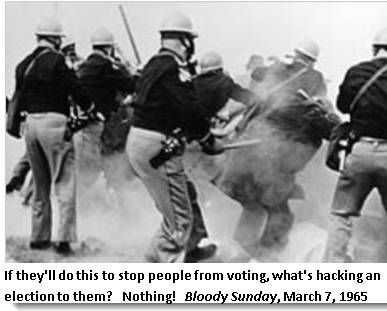
Bloody Sunday
Michael Collins
(Washington, DC) Our elections are officially privatized.  They are hidden from our view by design.
On November 6, your votes will be cast and tallied on voting machines manufactured and serviced by private companies.  The computerized voting machines run on software that is closely held as a trade secret by these companies.  Our elections officials are barred from examining the most important aspects of the software.  Why?  Because those same officials signed away our right to open access and inspection of the voting systems that tell us who won and who lost each and every election.  (Image: WikiCommons)
This is the most profound election fraud imaginable.  It affects every citizen, all 311 million of us.
Privatization occurred without our knowledge or consent.  Was our vote cast and counted properly?  We have no way of knowing.  Can we observe vote tallying at precincts and central tabulation locations?  Not likely. If you could, what good would it do to watch an encased computer running indecipherable software?  This violates prohibitions against secret vote counting in many state constitutions. Our elected officials could not care less.
But wholesale election fraud began long before voting and tallying machines entered the picture. That will be discussed at the end of the article.
As we approach November 6, it is important to understand two major sources of current election fraud.
The Amazing Anomaly and Vote Flipping for Romney – 102 Electoral Voted at Risk
A hard working team of volunteer researchers and analysts gathered raw data, precinct votes, for the 2012 Republican primaries.  Rigorous statistical analysis showed a specific pattern of suspected vote flipping that lead to highly improbable victories for Romney. This was termed the amazing anomaly by the research team.
Urban Density was factored out of the analysis, yet the anomaly remained. All precinct-level demographics available were tested to see if they could cause such an anomaly to no avail. Again, this amazing anomaly remained in the results.
Vote flipping involves exchanging votes from one candidate to another or several others. It is a clever way to benefit a candidate, victimize his or her opponents, while at the same time keeping the precinct vote totals the same. The researchers discovered that often, election officials count and compare only precinct totals with the Central Tabulator count. This simple, yet highly effective fraud strategy could have been undetected for years. In state after state, allegedly because of vote flipping, Romney showed unexplainable increases from the smallest to largest precincts.  The process was outlined recently in two articles: Rigged Elections for Romney? 10/22/12 and Part II – Rigged elections for Romney? 11/1/12.
The following eight states represent 102 electoral votes.  They all have two things in common.  They are tossup/battleground states and they all showed clear signs vote flipping during the Republican primaries, always in Romney’s favor.  Romney won six of the states (seven if you include his Iowa win, which was reversed).  These states will deploy in the Nov.6 general election the same voting machines, central tabulators, and election officials and their partners, staff from the private voting machine companies.
Here is the pattern found in the states above and others.  The pattern was always in Romney’s favor.  How likely is that?The graph of the Ohio primary below shows Romney’s increases from smallest to largeset precincts.  The probability of that pattern is an amazing anomaly since it is so improbable, statistical packages cannot estimate such a small probability; they round it down to ZERO. In other words impossible.  As you can see, Romney’s vote accumulation accelerates while Rick Santorum’s and Ron Paul’s decline.  At the end of the day, typical of Ohio’s close elections, Romney’s gains, the green line, pass over Santorum’s totals for a 12,000 vote victory.  Had Romney failed to gain 5.42% of the total vote through suspected vote flipping, he would have lost the Ohio primary. (See chart for details of election shift from vote flipping.)

See Graph of Ohio primary anomalies
Graph from Francois et al. research team.
Download of Excel for Ohio statewide precinct analysis
The graphs and impact of suspected vote flipping in Wisconsin’s 2012 primary are even more dramatic as shown here.  Romney would have lost Wisconsin, as well, were it not for the unexpected, highly improbable phenomenon reflecting suspected vote flipping. Certainly, after losing these two key states, a brokered convention would have ensued.
Romney’s vote total always expanded due to the suspected vote flipping pattern.  The other candidates lost votes in almost every case.

See graph of how Romney benefited from vote flipping

The research team shared its methods and findings with over 150 academics with specialties in election integrity, elections officials, and the general public.  The first two groups provided encouraging responses, but were unable or too busy to evaluate the compelling evidence of election fraud or to consider the implications.  There have been over 100 inquiries by motivated members of the pubic, however.  So the project continues.  It is clear that the people have to protect their own elections.
Watch the Post-Election Polls and Analysis
Rich Charnin has been studying and writing about election for early ten years.  He was one of the first researchers to discover the inconsistencies in the media consortium’s exit polling and the first researcher to look beneath the surface of the 2004 election. Charnin predicted the exact electoral count of the 2008 election and updates his blog daily.
His latest book, Matrix of Deceit: Forcing Pre-Election and Exit Polls to Match Fraudulent Vote Counts, shows how the media consortium uses their exit polls to ratify questionable elections.  The official exit polls released by the networks and major news outlets are adjusted before release to match the official election results.  Charnin was the first to point out that that nearly half the official media consortium’s  state presidential exit polls exceeded the margin of error in favor of Republicans and only three did so in favor of the Democratic presidential candidate.  The probability of that happening is one of those unfathomable improbabilities, one in several trillion.  Where are the experts, academics, and elections officials who prop-up an indefensible election process?  What do they have to say in their defense?  Nothing.
Election Fraud Didn’t Start Yesterday
Black citizens in the former Confederate states were the first targets of wholesale election fraud.
During the Reconstruction Era following the Civil War, black citizens were able to vote.  The Union Army troops stationed in the former Confederate states protected that right.  Black participation in elections was as high as 80% in some areas.  When Reconstruction ended as a result of the Compromise of 1877, Southern blacks lost everything, including their right to vote.  This lasted for nearly a century until the passage of the Voting Rights Act of 1965.  Between 1890 and 1960, each presidential election had at least five million fewer votes due to the loss of voting rights by black citizens in the South.  Imagine the change in elections without this theft of voting rights?

Stealing the vote from minorities was deliberate post-Reconstruction strategy developed by none other than the Ku Klux Klan and the Redeemers movement.  Programs like photograph identification found in key states are a descendant from the original efforts to disenfranchise Southern blacks. Laws that strip the vote from ex-felons also trace back to these racist efforts.  Nearly six million former felons are denied the right to vote.
Why is it so important to lock people out of the voting booth?
Why is it so important to keep private company voting systems that consistently produce odd and unexplainable results?
Power and control are the central motivations.  If your political program is to keep the majority down, you favor election fraud as an exquisite tool.  Treat the people like chumps by creating a façade of democracy and belittle anyone who questions the system by calling them conspiracy theorists.  Most importantly, never, ever admit that there might be something very wrong.
The manipulation of “official” exit polls or the complete cancellation of such polls in 19 states this year, teamed up with suspected vote flipping (in the most blatant way imaginable) represent an improvement of sorts.  Instead of targeting the minorities and poor, these programs are truly egalitarian. They target everyone.

This article may be reproduced with attribution of authorship and a link to this article.
The Money Party
Republican Primary Election Results Amazing Statistical Anomalies_V2.1
2008 – 2012_Elections Results Anomalies and Analysis V1.6
Rigged Elections for Romney 10/22/12
Part II – Rigged elections for Romney? 11/1/12 .
Polite Fascism Contracts the Right to Vote, May 13, 2008


October 31, 2012

bravo, rbi


The central bank and banking regulator of India, Reserve Bank of India, came out with its FY 2012-13 (April 2012 to March 2013) quarter review of monetary policy.I contributed an editorial on the RBI review for the newspaper I work for.

Here is what I wrote:

Bravo, RBI

By maintaining status quo on policy rates RBI has rightly looked at long-term benefits for the economy

In the prevailing atmosphere over the last many months the government, mostly through its finance ministry, has been able to successfully bulldoze its way in several areas of the Indian economy and financial system in order to prove a point or two to its detractors in the domestic industry and vested international circles that there is no economic policy paralysis in the country. From speeding up policy initiatives such as foreign direct investment to prodding financial sector regulators such as Securities and Exchange Board of India and Insurance Regulatory Development Authority to accede to demands made by the mutual fund industry and the insurance industry, the government has been able to get what it wanted. 

What stands out, and we are glad it does so, is that enormous pressure being put on the Reserve Bank of India by the finance ministry in recent weeks to cut policy rates did not bear fruit on Tuesday when RBI announced its FY13 second quarter review of monetary policy. It maintained status quo on the repo rate retaining it at 8 per cent level but cut cash reserve ratio by 25 basis points from 4.50 per cent to 4.25 per cent. 

The RBI governor, D Subbarao, while appreciating the downside risks to domestic growth from further deterioration in global macroecnomic conditions, was emphatic that the monetary policy had to focus on doing its bit to reign in the un-relenting high inflation levels which RBI has no doubt is not conducive for investment climate and consumer confidence without which no high growth can be had in the medium-term.

Despite the fact the CRR cut will enhance liquidity in the banking system by upto Rs 17,500 crore and the CRR has been bought down sharply by RBI from the 6 per cent level of last year, the finance minister expressed his disappointment at the lack of a repo rate cut. Such un-fettered expectations of the government from the banking regulator does not augur well for the independence. It is understandable for the industry associations to demand the lowest interest rates on the bank borrowings by their member companies but the same demand made subtly but surely by the government does not jell.
 
The government has itself done hardly much on the real macro-economic problems of high fiscal deficit and high current account deficit. Raising diesel prices by a meagre Rs 5 and putting a cap on subsidised domestic cooking gas cylinders will hardly make a dent in the rising fiscal deficit. These measures too came belatedly after all earlier political compulsions arising from state elections and presidential elections had expired. 

A fiscal roadmap laid out by the finance minister on Monday is welcome but without detailed plan of action on individual subsidy items it is only a promise and meaningless at that since the approaching 2014 general elections will soon give re-birth to political compulsions. Moreover, an actual implementation of the fiscal measures will translate into short-term pain of higher inflation as prices will be tuned to market forces. 

The RBI has, therefore, done right by not cutting the repo rates at this juncture. Capital investment by corporate borrowers will surely if rates are cut and lead to better economic growth but it will, if inflation does not subside, diminish the inflation-adjusted real rate of return for savers. 

India has perhaps the highest number of savers in the world and this fact should not be under-appreciated. It is not wise to assume that the long-term worst-case scenario of severe fallout from a very high fiscal deficit can be reasonably averted if economic recovery happens in the short-term by through low lending rates

October 29, 2012

mukesh ambani's reliance's unhealthy influence in cabinet reshuffle seen...


I share below a message received in my mailbox from a coalition of civil society groups on the unhealthy influence of Mukesh Ambani's Reliance Industries (RIL) in the latest round of cabinet reshuffle in the central government of India.


From: NAPM India
Date: 28 October 2012 17:37
Subject: Press Release 28th October, NAPM condemns UPA reeling under Reliance Pressure, Challenges transfer and pricing of Natural Resources against Nation’s Interest
To: napm-india , napmconveners

 National Alliance of People’s Movements (NAPM)
National Office: A Wing First Floor, Haji Habib Building, Naigaon Cross Road,
Dadar (E), Mumbai – 400 014 Phone - 9969363065;
Delhi Office: 6/6 jangpura B, New Delhi – 110 014. Phone: 9818905316
E-mail: napmindia@napm-india.org | Web: www.napm-india.org

Press Release                                                                         28th October 2012, Hyderabad
 
NAPM condemns UPA reeling under Reliance Pressure

Challenges transfer and pricing of Natural Resources against Nation’s Interest

No Privatization of Minerals and No forcible Acquisition for Private Projects

The news that the Petroleum minister Jaipal Reddy is again to be replaced by someone else, repeating the incidence that took place few years ago when Mani Shankar aiyar was replaced by Murli Deora, Ambani’s childhood friend. The very fact that Jaipal Reddy was the one who questioned the irrational demand by Mukesh Ambani’s Reliance Industries Limited (RIL) on escalating the prices of natural gas ,irrespective of the decision and agreement by the union government and RIL on the price to be steady till 2014,  this is one more example, just one of many related to RIL, one of the largest corporates in the country, pulling strings to change the player in the political domain that challenges its activities ,especially huge or even vulgar profit making.

NAPM condemns this, as an evidence of politician-corporate nexus and joint crime against people, who are left deprived when not the State exchequer but the corporates’ accounts are filled and swelling. It is Shocking and disgusting that even when the congress and NCP leaders are challenged at the center and in states, for their involvement in illegal allocation and transfer of land and other resources, at the cost of the public interest; they still have guts to take such an action mainly to give the Ambani’s a clean field. A stratergy to counter this will be worked out in its upcoming National Convention (9th biennial), from 17th to 19th November, at village Kiraloor, 15 Kms from Thrissur, Kerala.

While the loss that would occur if the price hike was accepted is quoted to be $ 6.3 billion, with the undue spread and spell of the RIL across the country and the sectors ranging from Oil & Gas to Infrastructure, telecommunications, theatres, retail, health, education.. right up to Satyamev Jayate, there is no doubt that it may go much beyond even the DLF’s swell, already exposed. It is the wicked game of acquisition of lands, with minerals attached to land, allocation of deep sea blocks, or transfer of the richest of our Nation’s Natural Resources to these private players; that is the worst and the highest level of misappropriation by the present rulers.

The millionaires such as Ambanis have been putting all undue pressures either through PMO, Minister or even through media, seeking concessions; while farmers without subsidy are compelled to commit suicides. It is high time that country demands total nationalization of our mineral resources, the only wealth that is luxuriously expended without any concern, neither for the State’s earning, nor for the environmental impacts and loss of livelihoods to the local populations of farmers and fish workers.

The Krishna Godavari basin issue was distortedly and deliberately presented as if the RIL were to limit its extraction of Natural gas worth approx $ 3 billion dollars, very recently. The fact is that on one hand this has been the tactic to get higher and higher price for their “Natural Product”, while on other hand it is the high incidence of subsidence (sinking of land) in the KG basin that should have compelled them to do so. Resulting in the sea ingress and destruction of paddy lands, as also threatening the habitats and livelihood of millions of people in the Basin, such an ecological impact should have been monitored by the Ministry of Environment and Forest. MOEF, just as other ministries have also been relying upon not laws or policies, nor public hearings but the RIL to plan its targets and profits, violating the laws.

Other examples of this include the power projects granted to Ambani, one in the name of Common wealth games and others without checking the economic feasibility and environmental sustainability, in fact the Reliance work in a threatened eco system of KG basin must come to a halt and this giant monstrous corporate must be prevented from any further investment and favours to facilitation for adding to its unconstitutional wealth, that is costing crores of toiling citizens in the country, destitution, malnourishment, unemployment to homelessness and hunger.

In this regard the Supreme Court can if it wishes to take a suo moto cognizance of the CAG reports to media reports, even in the frame work of its own judgment on 2G spectrum and beyond. If it does not, the People’s Movements that are fighting for no forcible acquisition of natural resources by the State for the private and PPP projects, simultaneously questioning pushing of plans and projects that transfer the resources from people to profiteers; will have to raise voice against “Unreliable  Reliance”.

The new Bill soon to be put up before the parliament is another attempt to continue the forcible acquisition for the private corporates and builders; bypassing the unanimous report by the all party parliamentary Standing Committee on Rural Development. This needs to be questioned and plans of, not only Ambanis but of Jindals, Tatas, Mittals, Adanis, Hiranandani to DLFs all are to be curtailed.

In Place of a weak Land Acquisition and Rehabilitation Bill; National Alliance of People’s Movements demands a Democratic Development Planning Act following the constitutional frame work of local self governance.


Medha Patkar              B.Ramakrishnam Raju          Saraswati Kavula         Shashank Rajwadi

For Details contact Madhuresh - 09818905316
===============================================
National Alliance of People’s Movements
National Office: Room No. 29-30, 1st floor, ‘A’ Wing, Haji Habib Bldg, Naigaon Cross Road, Dadar (E), Mumbai - 400 014;
Ph: 022-24150529

6/6, Jangpura B, Mathura Road, New Delhi 110014
Phone : 011 26241167 / 24354737 Mobile : 09818905316
Web : www.napm-india.org
Facebook : www.facebook.com/NAPMindia
Twitter : @napmindia

October 28, 2012

unwise safety net for ips

A month ago, a proposed safety net for IPOs was in the news. 

I wrote about it then in an editorial for the newspaper I work for. I share it below.


A net full of holes
The proposed safety net framework for IPOs is not a good idea

There is no dearth of props in the financial system and more so in the current economic situation fuelled by the government's pursuit of high growth, aggressively cheerlead by financial market players. Yet another one is being sought to be given to them. This time, the capital market regulator, Securities and Exchange Board, has moved ahead in its earlier consideration of a mandatory safety net mechanism for initial public offers in the capital market. 

This new measure aims to protect retail investors from a large dip in the price of an IPO in the first three months after its listing. Not only is the idea of a price protection regressive in modern financial markets as it distorts the natural price discovery process in the market, the convoluted nature of Sebi's proposed safety net mechanism will make the distortions only more worse.

In the past couple of months, the primary market advisory committee followed by the Sebi board have given their approval for the safety net measure and after formalising its broad framework Sebi, late last week, made public a discussion paper on it  on their website inviting comments from investors and other parties in the capital market before October 31. The discussion paper is just three and a half pages long and while length need not be an issue, for a measure which will be the first of its kind for primary market issues in the last 20 years. 

Earlier, before the 1991-92 financial market reforms abolished the Controller of Capital Issues, the central government had administrative control over price and premium of shares in IPOs. It was direct and full price management then and now, under the proposed new safety net measure, it will be indirect and partial. If, and only if, a couple of conditions are met will small retail investors be eligible for the safety net. In all of the three months immediately after the listing of IPO-issuing company's shares, the volume-weighted price has to be more than 20 per cent lower than the issue price and the gap between this fall in the company's price and that in the fall of either of the broad market indices, S&P CNX 500 and BSE 500, is also more than 20 percentage points. 

Effectively, it means the fall in the post-listing price fall should be at least 20 per cent and 20 percentage points over and above the general fall in the market. Once this  happens, then as per the other complex conditions set out by Sebi's proposed safety net framework, the actual cost for the promoters will range from just 1 to 7 per cent of the issue size. To make matters worse, as per yet more conditions, eligible retail investors could see only one-seventh of their allotted shares receive the benefit of price protection.

The convulated conditions will ensure that the final objective of restoring the diminishing confidence of primary market investors on account of fall in post-listing prices of IPOs is never met. Sebi and the finance ministry who is subtly applying pressure on Sebi to do this would do a better job of protecting investors' interests if they empower the retail investors with the discerning ability to choose the right IPO for investments. IPOs thrive only when secondary market is in a bull run and their pricing is inflated since most secondary market share prices are also inflated. 

Hefty commissions paid to lead managers and distributors during IPOs are the root cause of badly timed, aggressive mis-selling of IPOs at inflated levels. Coming down hard on these commission levels would automatically lead to retail investors being left alone to choose the right IPO.

September 27, 2012

give justice to the little girl if french consulate man in india did indeed sexually abused his daughter

It is not just Indians having influence or power, whether they be politicians, industrialists, financial market biggies, bureaucrats, CBI, police or any rich citizen, who try to get away from shameful and criminal acts. 

The news story from a weekly magazine, which I share below, highlights the probability of a French consulate man sexually abusing his 4-year old daughter. If true, it provides yet another example of how many citizens of western countries are wrong in their assumption they are the most civilised people on our planet. If they weren't blinded by such dangerous assumptions than the French consulate man would have probably not dared to do what he is alleged to have done and think he could get away with it.

If the incident given in the news below did indeed happen, I pray for the little girl to come out of her trauma and lead a healthy life, and for the abusive father to be brought to justice quickly. 


Here is the magazine news story:

http://www.tehelka.com/story_main54.asp?filename=Ws210912CRIME.asp
Posted on 21 September 2012
Wife harassed for reporting French diplomat for child abuse
While the police has filed a chargesheet against Pascal Mazurier, wife Suja is being victimised, reports Imran Khan

The high profile case of a French consulate official allegedly raping his four-year-old child not only caught the headlines in Bengaluru but also sent shockwaves across the French expatriate community in India. The fact that the complainant was the child’s mother resulted in an outpouring of support for the victim and anger against Pascal Mazurier, the consulate official. However, as the case is heading towards a legal conclusion, the indifference of the police and the French consulate and their sympathy with her husband has made the battle to get justice much tougher for Suja Jones, the mother.
On 19 June, Pascal Mazurier, 39, Deputy Head of Chancery at the French consulate in Bangalore for the last four years, was arrested by Karnataka police on charges of sexually abusing his four-year-old daughter. The complainant, his Keralite wife for the last eight years Suja Jones Mazurier, 37, who had for long doubted her husband’s intentions towards their daughter, had instructed her maid to keep a watch on Pascal when he came home for lunch.
The maid, who found Mazurier locked up with the girl for four hours, immediately informed Suja, who later took her daughter to Baptist hospital for medical examination. Suja Mazurirer’s doubts were confirmed when doctors at the hospital informed her that an attempt to rape was made on her daughter. A distraught Suja, based on the medico-legal report and help from the local NGO Enfold India, filed a complaint against Pascal on 14 June at the Cubbon Park police station alleging rape of her daughter. Apart from a daughter, Pascal and his wife have two sons aged seven and two.
Even though a complaint of attempt to rape was filed, it took police five days to arrest Mazurier, who contrary to their belief, did not enjoy diplomatic immunity. “The consul general of France Dominique Causse himself had pleaded with the Commissioner of Police, Bangalore not to arrest Mazurier,’’ informs Suja Mazurier. Buckling under pressure, the Bangalore police later charged her husband under Section 376 of the Indian Penal Code.
Even before the dust could settle, she came under intense attack from the expatriate community and from the French consulate. There were email campaigns against her questioning her intention. Since both Pascal and Suja hold a joint bank account, it was alleged that she did it to gain complete access of his money. "After much effort, I have finally been able to access some funds present in our bank account in France. As a result, I believe I can at least provide for my family for now. I would like to extend my gratitude to a French-speaking well-wisher who had to call on my behalf because the professionals involved repeatedly ignored my calls and emails over the weeks. Even then, it required a lot of convincing and further letters to finally get through. I was not aided in any way by any consulate officials to do this. Parallel pleas, numerous and fervent, to the consulate for help ultimately were rewarded with an offer for assistance from the consul general, which was not only encouraging but no longer necessary as my own independent efforts with the bank had yielded results." adds Suja Mazurier.
During the investigation, aggrieved Suja had to even write a letter to the city police commissioner asking for change of investigation officer who subjected her to intense questioning. “Were you sexually abused as a child? Do you hate France? Do you hate your mother-in-law? Did your parents know about your pre-marital relationship? If you lied to your parents about that, what proof that you are not lying now?” These were some of the questions thrown at her by the previous investigating officer.
The police also did a physical examination of Suja's daughter in the labour room of the government-run Bowring hospital. “There was blood everywhere on the floor. My daughter was screaming and I was crying,” recounts Suja. The swab samples of her daughter were later sent to the Forensic Science Laboratory in Hyderabad, which gave a report saying that they didn’t find Pascal’s DNA in it. However, the doctors didn’t even find the girl’s DNA in it, leading to a suspicion that the sample was tampered.
The police is now demanding that blood samples of the girl child should be given to clear this doubt. Investigating officer in the case Assistant Commissioner of Police Venkataswamy speaking to TEHELKA said, “This is the first time we are taking the blood sample. We want to send blood samples to other laboratory as the DNA report is inconclusive. Further clarification is required but we cannot compel her to give it’’.
“We have no issues of giving the blood samples but they should state it for what reason they are taking it,’’ says Suja Mazurier.
Meanwhile, the Bangalore police have filed a 160 page chargesheet on 17 September accusing Pascal of rape based on circumstantial evidence. The police however have refused to give them a copy of the chargesheet asking them to approach the court. Suja’s counsel advocate Pramila Nesargi said, “The defense lawyer has already been given a copy of it. But it is being denied to us.’’ Pascal’s lawyers have moved the High Court demanding bail. The next hearing is scheduled on Monday 24 September.
Imran Khan is a Senior Correspondent with Tehelka.
imran@tehelka.com