Showing posts with label human rights. Show all posts

January 19, 2012

life in general: un-democratic iranian government's wrongful long imprisonment of a human rights lawyer

Iran is far from being a democratic country, notwithstanding any well-deserved contempt United States of America gets for its nefarious designs on Iran.

A few ways of how the oppressive Iranian regime carries out its abuses are through its criminal confinement of human rights lawyers and through its criminal suppression of women in the country. I share below from sources on the interent an example that encompasses both.

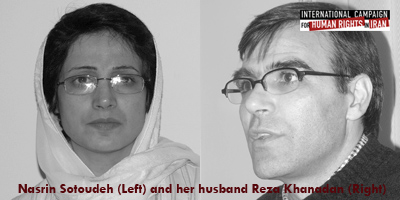
An Iranian woman lawyer who has fought for the rights of children and women has been criminally imprisoned since September 2010. Below are two sources which provide more insight on the case.


1)  http://kractivist.wordpress.com/2012/01/19/free-nasrin-sotoudeh-human-rights-defender-iran/ 


Free Nasrin Sotoudeh- Human Rights Defender Iran    Nasrin Sotoudeh is a lawyer, human rights campaigner and women’s rights activist.

Nasrin has defended the rights of many activists who have been arrested, tried unfairly and jailed, including Nobel Peace Laureate Shirin Ebadi. Nasrin has spoken publicly about the shortcomings of the Iranian legal system and is famous for defending young offenders on death row. Her activities made her a target, and she was arrested in September 2010.

In January 2011, Nasrin was sentenced to 11 years in prison. In mid-September 2011, the Appeals Court reduced her prison sentence to 6 years and a ban against practising law from 20 years to 10. The charges against her include “acts against national security”, “anti-regime propaganda” and belonging to the Centre for Human Rights Defenders.

For most of the past year, Nasrin Sotoudeh has been in solitary confinement in Tehran’s Evin Prison. Three hunger strikes have weakened her health. She took that drastic action to protest her imprisonment, lack of trial and her conditions of detention.

Her detention affects many others. By repressing lawyers like Nasrin and by marginalizing the Iranian Bar Association, the government denies other critics of the government the right to access competent legal representation. One of her own lawyers is currently in detention, too. Nasrin’s husband, Reza Khandan, was pressured with threats and brief imprisonment to make his wife stop her activities. He remains at risk of further harassment and faces a possible trial and imprisonment. They have two children.

She belongs to several organizations including the One Million Signatures Campaign to Change Discriminatory Laws Against Women, and the Society for Protecting the Rights of the Child.

Amnesty International considers Nasrin Sotoudeh to be a prisoner of conscience because she is in custody only for peacefully exercising her rights to freedom of expression and association. This includes her professional work as a lawyer.

In the words of Nasrin’s husband, Reza Khandan:

“If any government can block the power of a human rights attorney, its hands are free to treat its critics and opponents in any manner it desires. Unfortunately the international community allowed the government to break this barrier.”

Nasrin Sotoudeh, as you will know, was sentenced on Sunday, 9th January 2011, to 11 years imprisonment.
Reportedly, this includes 5 years for ‘violating the Islamic dress code (Hejab)’ in a filmed acceptance speech, in which she was accepting a Human Rights Prize by the International Committee on Human Rights, in 2008. She was not permitted to leave the country, at the time, to travel to Italy to accept the award.

A further 5 years of the sentence is for ‘acting against the national security of the country’ and 1 year is for ‘propaganda against the regime’.

She has also been banned from practising law and leaving the country for 20 years. It is possible that an appeal against the sentence can be requested within 20 days.

Nasrin’s husband, Reza, was summoned to the Revolutionary Court. In a statement, he said:

“I have been asked to appear at Branch 1 of the Revolutionary Court. In the written summons, the word ‘defendant’ was used when referring to me. Of course I was also summoned once about ten to twelve days before my wife was arrested and at the time I was warned about the interviews I had given.”

The International Campaign for Human Rights in Iran says the ‘UN Human Rights Council Should Act to Address the Crisis.’ The ICHRI also says that Nasrin has ‘reportedly been tortured in prison in order to force her to confess to crimes’.

I would like to draw your attention to important legal points raised recently by renowned Human Rights Lawyer, Mehrangiz Kar, when discussing Ms Sotoudeh’s case:

“Under the concept of a fair trial, the key thing is to have access to lawyers and this is not being practiced. It is routinely being violated.
Article 168 of the Iranian constitution states:
‘All political prisoners are afforded right to a jury trial and must be public’.

When there is not a jury during the trial, that trial is not legal even under the Islamic Republic’s structure. This has been routinely violated since the 2009 elections.”

On December 10, 2011 Nasrin Sotoudeh the International Campaign for Human Rights in Iran launched the “Free Sotoudeh Project,” a campaign aimed at building international support for the release of imprisoned human rights lawyer Nasrin Sotoudeh and highlighting the tragic situation of Iranian prisoners of conscience.


2)   http://www.feministschool.com/english/spip.php?article180 

Thursday 4 December 2008 

Feministschool: Feminist school wanted to organize a ceremony in honour of Nasrin Sotoudeh, after she won the first human rights international prize 2008 in South Tizol (Italy),also we are proud of the fact that Shirin Ebadi who received an award with the Tolerance prize which the ceremony took place in Germany. Sadly the women rights activists were not given permission to proceed with the ceremony , hence we decide to dedicate special page in our site for this event as a result we have placed the speeches of some of the speakers.
about Nasrin Sotoudeh
Nasrin Sotoudeh , lawyer and women rights activist , is a well known lawyer for Iranian women ’s movement whilst its activists are in prison. Nasrin was born in 1963 in Tehran and graduated in International law in beheshti University in 1991 then she started her journalism activities with Daricheye Goftegoo ( the window of dialogue)magazine. also she has written articles for newspapers such as : Jame’eh ,Toos,Sobh e emrouz and Aban . Married in 1994 and now she has two children.
In 1995 Nasrin became an understudy and managed to acquire her Licence to practice Law within 8 years, Nasrin who has taken the cases for a lot of the activists is now awarded with the Human Rights International prize.
She is well known for her activities in human rights for children and in particular against the hanging of children under the age of 18, and women’s movement in particular Campaign of one million signatures Demanding Changes to discrimiatory Laws.
Nasrin Sotoudeh and Mansoureh Shojaee also were summoned to Revolutionary Courts , and appeared in the Revolutionary Courts. They were accused of "endangering national security by having uncommon relationships with Iranians who live overseas". In addition, they were told by "security forces representative" that " we warned you off over the phone and forbade you to go to overseas before you went to airport.
Nasrin Sotoodeh and Mansoureh Shojaee by invitation of some of Iranians women from the south of Larestan and Evaz of Iran who are currently residents in Dubai , were going to go to Dubai to take part in a celebration of 8 March when the officials banned Mansoureh Shojaee from travelling and seized her passport. However, they told Nasrin Sotoodeh that she could travel. But she avoided travelling and told them that she is representing Mansoureh Shojaee and she has to stay with her. They were questioned by security forces for 5 hours in airport.
Nasrin Sotoudeh also was arrested with 8 other activists outside of the Rahe Abrisham Gallery just prior to a small, peaceful assembly planned to commemorate June 12th, the day that has been chosen by Iranian women’s rights activists as their national day of solidarity to object harmful actions which attempt to silence Iranian women.
Some articles in English in special page in Feminist School web site about the ceremony on Nasrin Sotoudeh’s honour :
- All my Clients / Mansoureh Shojaee

Nasrin Sotoudeh’s article in English in Feminist school:

January 17, 2012

life in general: a severe example of nasty custodial torture in india

The last few months has seen a severe example of custodial torture in India. It is about a woman named Soni Sori who is alleged to be a Maoist (a banned outfit in India) by the Indian government. Whether she really is a Maoist is yet to be confirmed but what is reasonably clear is the unwarranted and, in fact, criminal, use of torture afflicted on Soni Sori by the Indian police acting under the instruction of the Indian state.


Below are three write-ups and one video that throw more light on the goings-on in this matter.

1) http://kractivist.wordpress.com/2012/01/14/womens-groups-stopped-from-meeting-soni-sori-in-raipur/


*WOMEN’S GROUPS STOPPED FROM MEETING SONI SORI IN RAIPUR*


*DEMAND IMMEDIATE ACTION ON PERPETRATORS OF CUSTODIAL VIOLENCE ON SONI SORI


* A team of women representing various women’s groups from across the country were in Raipur on 12-13th January to meet Ms. Soni Sori, currently lodged in Raipur Central Jail. Ms Sori is a tribal school teacher who has been hounded by the Chhattisgarh Police as a Maoist conduit. She was arrested in October 2011 and was brutally assaulted sexually in police custody on the night of 8-9th October.
Even after applying for permission as per procedure and repeated requests to various concerned officials on 12th, the women were denied permission to meet her, despite already having an assurance from the Principal Secretary, Mr. Baijendra Kumar, during his visit to Delhi in October.For two whole days the team was shuttled from one authority to the other and back, with each and every official avoiding taking a decision or give in writing any denial or reasons for it. Finally, permission was denied on 13th citing `security’ concerns. We feel that such alleged `security’ concerns are being used as a smokescreen to prevent us from meeting her, and this constitutes a violation of Soni’s rights as a prisoner. Further, we fail to understand what security threats an all women’s team, following all proper procedures and which consented to meet her in presence of the jail authorities, poses to the jail. Even the State Human Rights Commission, when approached by the team, refused to take cognizance of the matter, stating that denial of access to an undertrial does not constitute any violation of human rights of the undertrial.
The team expresses deep anguish and horror at the brutal physical and sexual torture she was subjected to when in police custody, which included giving her electric shocks, stripping her and inserting foreign objects into private parts. This torture was carried out under the supervision of a senior police official, despite directive from the Delhi High Court to the Chhattisgarh police to ensure her safety. The medical report of Kolkata NRS Medical College and Hospital, where stones were recovered from her private parts, confirms the brutal sexual assault.
We feel that Soni Sori`s case is of national importance and urgency for several reasons. Firstly, such barbaric behaviour by police had been foreseen even before Ms. Sori was taken into custody and had been clearly placed before the Sessions Court and High Court in Delhi, when her custody was sought by the Chhattisgarh police. While such custodial torture is a blatant violation and a matter of concern, *that it can happen despite judicial scrutiny and monitoring is deeply disturbing and of even greater concern.*
Secondly, this is one of the rare cases where the allegations have been substantiated by incontrovertible evidence in the form of an independent medical report conducted under the orders of the Supreme Court. Yet no action has been taken. Despite the seriousness of these violations, the Chhattisgarh authorities have not even instituted an enquiry, let alone taking action against the officials concerned. In addition, it is also preventing any attempts from independent women’s groups to meet with her.
Given the brutal treatment meted out to Soni Sori, and the overall situation of conflict and repression prevailing in Chhattisgarh, we are deeply concerned about the situation of women, in general, and specifically of other women prisoners in Chhattisgarh. Speaking in the larger context efforts to get information by human rights activists about under trails in such areas has unsuccessful. We demand immediate suspension of the officers concerned pending enquiry. Free access of individuals and groups to meet with Soni Sori and her rights as an under trail should be upheld.
The members of the team that visited Raipur consisted members from Saheli, Delhi; Women Against Sexual Violence and State Repression (WSS), Delhi; WSS Orissa and Madhya Pradesh Mahila Manch, Bhopal.


2)   http://www.sacw.net/article2445.html
PEOPLE’S UNION FOR DEMOCRATIC RIGHTS
PRESS STATEMENT
9 December 2011
Soni Sori Case : our freedoms are at risk because people’s concerns receive a short shrift at the hands of the judiciary


Peoples Union for Democratic Rights is distressed at the hiatus between the sharp observations of the Supreme Court judges and their timid operative orders and judgments. If there was any doubt over this it has been laid to rest by the recent orders of the apex court hearing the case of Soni Sori and the clarification offered by a bench of the Supreme Court in the much touted judgment on the issue of SPOs.
After her arrest in Delhi, Soni Sori had pleaded before three judges of the Saket District Court when her transit remand was being heard, that were she to be handed over to the Chhattisgarh police, she would definitely be tortured. Indeed she had pointed to the judge at the Saket district court that one member of the police team which had come to take her in their remand and escort her to Chhattisgarh had tortured her on a previous occasion. Her pleas fell on deaf ears.
When her complaint of torture including sexual violence inflicted on her was submitted before the Supreme Court, the judges chose not to intervene. And now when the medical check-up ordered by the court by a Kolkata hospital has established that stones were recovered from her private parts, the veracity of her charge stands corroborated. Instead of taking cognition of this and immediately moving her to safety of a jail outside Chhattisgarh, the apex court on 2nd December 2011 gave the state authorities 45 days to respond to the medical report and meanwhile merely shifted her to Raipur jail from Jagdalpur jail in the same state.
Thus the very same delinquent police force, its personnel and associated authorities have got permission to incarcerate her for an inordinately long period, a period sufficient for the state government to threaten, brow-beat and destroy Soni Sori before its prepares its response. It appears that custodial rape and torture of a woman, adivasi at that, does not enjoy any premium as there is greater concern for the prestige of the state authorities engaged in the valiant game of prosecuting a war against its own people in the tribal belt of India. The order of the Supreme Court has also risked Soni Sori’s safety further by shifting her to Raipur jail as her travel to the Dantewada court now entails a journey of 22 hours. It threatens her already frail health, puts her in prolonged police custody during transit and provides the government an easy alibi to deny her access to the court altogether.
In the SPO case the apex court bench watered down, if not trivialized, its original order issued on 5 July 2011 which had directed the Central government to desist from providing any funds for supporting directly or indirectly recruitment of SPOs and engaging them in counter-insurgency activities and had declared that the appointment of SPOs as part of regular police as unconstitutional. Thus the deployment of SPOs anywhere including in J&K, North East, Bihar, Jharkhand and West Bengal became illegal. By agreeing to remove reference to central government and by confining the judgment to Chhattisgarh alone and by maintaining scrupulous silence over how the Chhattisgarh state got around the restriction by raising a new force, the Supreme Court restored everything it had declared to be unconstitutional and thereby trivialised its own judgment and observations.
The only rationale for the issuing of such orders is that once ‘national security’ is invoked, the Courts, even the apex Court, fall in line behind the Executive. The most recent order on the deployment of SPOs and that regarding Soni Sori’s custodial torture show the Supreme Court in poor light and even more regrettably show it to be sacrificing people’s fundamental rights at the altar of “national security”.
For those of us who perceive the judiciary, at least its higher levels, as a protector of people’s interests there is salutary message: our freedoms are at risk because people’s concerns receive a short shrift at the hands of the judiciary as and when the executive invokes national security. Thus, radical observations and timid, if not trivial, operative orders must be condemned.
Harish Dhawan, Paramjeet Singh
(Secretaries)


3) http://www.binayaksen.net/2011/10/soni-sori-to-sc-sp-gave-electric-shocks-undressed-and-tortured-me/


POSTED AT OCTOBER 30, 2011 // PRESS REPORTS 
  Despite a Delhi High Court directive to the Chhattisgarh police to ensure  the   safety of the jailed adivasi teacher who had apprehended custodial torture, Soni Sori has alleged that in clear violation of the Court’s order, the Dantewada SP gave her electric shocks, underdressed her and tortured her on the night of October 8. In a letter addressed to the Supreme Court, and received by a social activist in Delhi today, Sori has described the torture to which she was subjected by the Superintendent of Police, Ankit Garg, and has demanded to know who is responsible for her condition.
On the night of 8.10.2011, from 12 midnight to 2:30 am, SP Ankit Garg called me into a room in the police station, gave me electric shocks (current shock), took my clothes off and severely tortured me. Why has no action been taken against him? Sori has asked in the letter in Hindi, a scanned copy of which is attached herewith. Sori, whose case is currently being heard in Delhi, has written this letter on a small scrap of paper and asks the apex court five incisive questions.
Describing herself as a suffering adivasi women who is also a daughter and sister of this country, she asks the Court to tell her who is responsible for the brutal custodial torture to which she has been subjected by the police in Chhattisgarh. It may be recalled that Soni Sori had apprehended this physical torture when she was picked up by the police in Delhi, and had moved the Sessions court and the High Court in Delhi to oppose her remand to the custody of Chhattisgarh police. Keeping her fears in mind, the Saket Court in Delhi had awarded her custody to the Chhattisgarh police only upon receiving their assurance of her safety. The Delhi High Court also asked the Chhattisgarh police to submit a report listing out steps to ensure Soni’s safety.
However, as Soni points out in this recent letter, despite these safeguards and the assurance given to her by the Saket Court, she was tortured brutally, both mentally and physically, by the Chhattisgarh police. Why did the police do this to me, why was this allowed to happen? Soni asks the Supreme Court in this letter. Describing her police harassment over the past year and a half, she writes about how the police kept showing her as an absconder in half a dozen cases, even though she was meeting with them, going to the police station and regularly attending her job as an ashram school teacher, as evidenced by the entries of the school attendance register. Why did the police not arrest me at that time? asks Soni in this letter. Referring to the most recent case, in which the police alleges that Soni has acted as an intermediary between Essar and the Naxalites, she claims that she was asked by a police constable Mankar to flee from the place, which has made her into a criminal.
In the letter, Soni asks the apex court why no action has been taken against the erring police constable. Soni also refers to the fact that she was kept chained to her hospital bed when she was undergoing treatment for her injuries due to custodial torture in the Raipur hospital,which is explicitly prohibited under Supreme Court orders. At the end of the short letter which lists these five questions, Soni plaintively asks the court, Who is responsible for my condition? The Chhattisgarh government or the police administration? Soni affirms in the letter that she is still on hunger strike since she has still not obtained justice. Social activist Himanshu Kumar says that this letter will be delivered to the Supreme Court once it reopens on Monday and notes,These questions which Soni is raising are important not only for her, but for all of us in this country. We must be prepared to face these questions and ensure that our democracy is strong enough to answer them.
For more information contact: Himanshu Kumar ph: 9013886571 email: vcadantewada@ gmail.com
Letter for the Supreme Court
1. Why are my feet chained?
2. Mankar constable is the culprit in the Essar case. He made me into a criminal by asking me to abscond. Why is there no action taken against him on this?
3. For a year and a half, the police have been harassing me by lodging false cases against me. I used to openly come and go in front of the police force. I was called at the police station many times, and I used to go there. Why did they not arrest me at that time? For no reason, they declared me as an absconder, even though I was regularly doing my service at the ashram school at that time.
4. I was brought here from the Saket Court in Delhi by promising that there would be no physical or mental torture, and I believed this to be the order of the court and came here. Then why did the police do this to me (torture me), why was this allowed to happen?
5. On the night of 8.10.2011, from 12 midnight to 2:30 am, SP Ankit Garg called me into a room in the police station, gave me electric shocks (current shock), took my clothes off and severely tortured me. Why has no action been taken against him? Today, who bears the responsibility for my condition? The government of Chhattisgarh or the police administration? I am a suffering adivasi woman and I want to the Supreme Court to answer my question. I am also a daughter and sister of this country. Why did this happen to me? This is why I have not yet broken my hunger strike.
Applicant Mrs. Soni Sori Central Jail, Jagdalpur


4) Video
http://www.youtube.com/watch?v=a5lO6cEcUeI


December 12, 2011

life in journalism: telling it to the media like it is


I have written a post on this blog, many months back, about how media should not indulge in giving awards to anyone. I believe the best recognition a genuine person or entitiy can receive is by regular coverage of the work being done by that person or entiy.

In a latest incident, a media TV channel, CNN-IBN, nominated, for an award on human rights, to a Kashmir-based activists group. The group has not only rejected the award but given a sharp hearing to CNN-IBN that it would be better for the media to cover its activities in their reportage and not indulge in frivolous awards. 

Here is what the Kashmir-based group has stated in a statement:

http://kafila.org/2011/12/11/parveena-ahangar-rejects-cnn-ibns-nomination-for-indian-of-the-year-2011/#more-10877

his press release has been issued by the PARVEENA AHANGAR-led ASSOCIATION OF PARENTS FOR DISAPPEARED PERSONS
Srinagar, December 10, 2011:  On this ‘International Human Rights Day’, December 10, 2011, the APDP (Association of Parents of Disappeared Persons), Srinagar, wishes to state that there is something obscene and perverse in the manner the CNN-IBN has nominated our organization for the ‘Indian of the Year 2011’ award. Sometimes, human rights can be violated by merely mocking those who struggle for human rights.
The channel and its associates are promoting this ‘award’ in all their publicity material as a recognition for “architects and ambassadors of Brand India”. The APDP would like to forthwith REJECT and condemn this gratuitous nomination of our organization for this award which smacks of being yet another attempt by corporate Indian media to cover-up and neutralize the crimes of the Indian state in Kashmir.
We believe there is something sinister in the way our organisation, which has been relentlessly struggling for core human values like freedom, dignity and justice in the Valley in the face of brutal state repression – largely condoned by the corporate media – has been drafted into the eclectic ‘menu card’ of shortlisted nominees just to buy some credibility to the ‘award’. The CNN-IBN or its associates certainly did not consult us before including our name on the nominees list.
The nomination states, ‘The award recognizes the Indian(s) whose contribution to the country in a calendar year has strengthened the foundation of our society and has helped build Brand India in the process. The pinnacle of Indian achievement….’
Applied in the context of our organization, this is patently absurd. The APDP’s struggle for justice and accountability has never been about “building Brand India” but about questioning and challenging Brand India and its trampling over the rights and lives of the people of Kashmir. We refuse to allow ourselves to be co-opted into that brutal system and demean our struggle for ‘rights’ by being foisted upon with some self-styled award. Particularly, when it seems obvious that our name is on your list merely as a ‘decoration’ to help prop up your credibility.
The award citation describes APDP as an organization ‘relentlessly highlighting the issue of missing persons in Kashmir, and forcing the government and rights groups to acknowledge and act’.
Describing the cases of enforced disappearances in Kashmir as that of ‘missing persons’ and claiming that due to efforts of APDP the government and its agencies have acted and acknowledged the issue of enforced disappearances in Kashmir, is both misinformed and misleading.
We wish to place on record that there has been no formal response from the government agencies or institutions on the issue of enforced disappearances in Kashmir. The APDP have identified the perpetrators of the crimes, and there are thousands of cases pending in the Srinagar High Court seeking sanction for prosecution of the accused. However, draconian laws like the AFSPA (Armed Forces Special Powers Act) in Kashmir continue to provide them complete impunity. To claim that the government and its agencies have responded to these gross acts of human rights violations and has ‘acted’ or punished the guilty is a blatant falsehood.
This nomination is a farce. Such nominations take away from the struggle that we as the Association of Parents of Disappeared Persons have been fighting for past two decades. It also makes a mockery of the trauma and sufferings of the Kashmiri people.
The only real ‘award’ the news channel can bestow upon us is consistent and honest reportage of the heinous crimes committed by the armed forces in Kashmir and highlight the struggles and sacrifices of the people of Kashmir for justice and freedom.
We demand that CNN-IBN forthwith remove our name from their nominee’s list.
PARVEENA AHANGAR
Spokesperson,
Association of Parents of Disappeared Persons (APDP)

January 27, 2011

life in general: human rights: a facade of action

Human Rights Watch has just released a World Report (downloadable here) highlighting events in about 90 countries with every country covered in a separate chapter. Out of three thematic essays accompanying the report is one titled "A facade of action" that I found very insightful.

I want to connect what this essay says with what a three-judge bench of India's Supreme Court remarked earlier this month on 20 January. A newspaper reported, "The Supreme Court (SC) on Thursday pulled up social activist Teesta Setelvad, who has been fighting for Gujarat riots victims, for approaching an international human rights body raising the issue of protection for witnesses. The court, which was seized of a law suit seeking transfer of cases from Gujarat to another state, expressed its displeasure on Setelvad’s move. “We do not appreciate that other organisations interfere in our functioning. We can take care of (them) ourselves and cannot get guided by others. It is a direct interference in our functioning. We do not appreciate it,” a bench of justices DK Jain, P Sathasivam and Aftab Alam said. Setelvad-run NGO, the Centre for Justice and Peace (CJP) had sent a letter to the Geneva-based office of the high commissioner for human rights, associated with United Nations, giving details of the proceedings in the Godhra riots cases. When Harish Salve, who is assisting the court in this case, drew the judge’s attention towards Teesta’s letter, an anguished bench told her counsel Kamini Jaiswal that CJP chief seems to have “more faith in foreign organisations than this court”. “It seems that witnesses would be protected by these organisations,” the bench remarked, adding if such letters are written then the court would pass the order without hearing the contentions of the CJP”. “If you send such letters then we would hear the amicus curie and pass the order (without hearing you),” the court warned. "All the cases are being monitored by us, we do not like any correspondence of her with foreign agencies’’, the court added. We do not appreciate letters sent to a foreign country. We do not approve of such a letter. Tomorrow, you will report these (SC) proceedings to them. This letter shows that you have more trust in them.”"

I think if Indian court judges are confident that they are doing their job properly then why have any apprehensions of any international human rights body being updated with any detail of any court case in India. This betrays arrogance on the part of Indian judiciary and is very unfortunate.

I connect with what the writer of the essay "A Facade of Action" in the Human Rights Watch's World Report, which I refer to above, says, "In last year's World Report, Human Rights Watch highlighted the intensifying attacks by abusive governments on human rights defenders, organizations, and institutions. This year we address the flip side of the problem-the failure of the expected champions of human rights to respond to the problem, defend those people and organizations struggling for human rights, and stand up firmly against abusive governments.
There is often a degree of rationality in a government's decision to violate human rights. The government might fear that permitting greater freedom would encourage people to join together in voicing discontent and thus jeopardize its grip on power. Or abusive leaders might worry that devoting resources to the impoverished would compromise their ability to enrich themselves and their cronies.
International pressure can change that calculus. Whether exposing or condemning abuses, conditioning access to military aid or budgetary support on ending them, imposing targeted sanctions on individual abusers, or even calling for prosecution and punishment of those responsible, public pressure raises the cost of violating human rights. It discourages further oppression, signaling that violations cannot continue cost-free.
All governments have a duty to exert such pressure. A commitment to human rights requires not only upholding them at home but also using available and appropriate tools to convince other governments to respect them as well.
No repressive government likes facing such pressure. Today many are fighting back, hoping to dissuade others from adopting or continuing such measures. That reaction is hardly surprising. What is disappointing is the number of governments that, in the face of that reaction, are abandoning public pressure. With disturbing frequency, governments that might have been counted on to generate such pressure for human rights are accepting the rationalizations and subterfuges of repressive governments and giving up. In place of a commitment to exerting public pressure for human rights, they profess a preference for softer approaches such as private "dialogue" and "cooperation.""

April 07, 2010

life in general&financial markets: extremism on both sides -- maoists & government


The tragedy that struck the families of the 74 Centre Reserve Police Force (CRPF) men who were killed in a attack by Maoists is distressing. These CRPF men, coming from non-affluent backgrounds and in their jobs primarily for a little bit of financial security, are the victims of not just the Maoist extremists who deserve no empathy for their indiscriminate violent methods but also of the machinations, apathy and inefficiencies of the powers-that-be in the central government of India as well as several state governments in the country.

P. Chidambaram, the Home Minister, was earlier the Finance Minister. There have been several cases of companies, bureaucrats and politicians colluding to brutally oust the remote people of India living in tribal and forest areas where the companies want to set up their mining and other industrial projects on the back of huge governement subsidies (that you and me as India's taxpayers ultimately bear).

There was a genuine resistance from the people and this got support from some concerned citizen groups all over the country. Hiding behind this genuine resistance, the Maoists took to violence against government forces and agents in those areas. The companies started complaining to the Finance Minister (Chidambaram then) and the Prime Minister of India, Manmohan Singh. They (along with Montek Singh Ahluwalia, Kamal Nath and other members of the coterie that turns a blind eye to the extreme violations taking place of human rights and environmental laws in those remote regions of India) must have decided on a strategy.

The first step was to transfer Chidambaram from the Finance Ministry to the Home Ministry as the latter is in charge of internal security matters of the country. Chidambaram would get the companies to provide him with details of which areas they want to set up their projects in (whether or not they are in genuine compliance of ecology laws and human rights clauses of Indian laws) and then use the paramilitary force (such as CRPF) to suppress the genuine resistance of the affected people using the Maoist violence as a convenient excuse.

So it has been a war by the Indian government, supposedly against Maoists, in the last few months. Maoists receive their arms from international arms suppliers (mostly private extremist organisations but sometimes quasi-government arms manufacturing companies). That the Maoist violence should be put a halt to is a given but at least it can be done without endangering the lives of poor paramilitary force troops on whom the government and Chidambaram does not wish to spend adequately on their salaries and training. Read the full text of the news story (that I am giving below) about how stupid it was for CRPF men to be blindly asked to enter a forest at dawn and how they were sitting ducks.

Simultaneously, the government of India should do away with its nefarious intentions behind the reckless and blind approvals it is granting to companies in the remote areas of India for mining and other projects. 
 

The newsreport:

http://www.mumbaimirror.com/article/3/2010040720100407024900498322cb9a3/Bloodbath-in-Chhattisgarh.html

Operation Green Hunt is flawed: Experts
New Delhi: The gruesome killing of 75 security personnel by Maoists in the jungles of Dantewada in Chhattisgarh brought the faultlines of Operation Green Hunt, the massive mobilisation of forces against Naxals, into the open.

Leading security experts like former Punjab Director General of Police KPS Gill and Ajai Sahni of Institute of Conflict Studies questioned the merit of sending policemen to battle the Maoists without any intelligence or preparation.

“What is the objective of these operations? How can they send a company of 120 men into the jungle - roaming, hunting for Naxals without any back-up or support? What were they expected to do? These men were sitting ducks. They are not IIT graduates or men of high intelligence,” said Singh.

Singh was adviser to Chhattisgarh Government in 2003-04 for tackling Naxals.

According to Singh, there was no point in walking into the Naxal territory and attacking them without precisely assessing their strike capacity.

“You will launch an attack after which they disperse into the jungles and regroup to mount a counter. They did it in Dantedwada, in Lalgarh before that and a number of other places. We must have the intelligence otherwise we will simply lose our uniformed men to such attacks,” Singh said.

Sahni pointed that the political class suffers from the problem of continuously doing things without any planning or strategy.

“When they do not have a strategy they call it an Operation. Do you know the total central forces deployed for the entire anti-Naxal operation is 57 battalions - each battalion will have 400 men,” he said, adding, “That means altogether about 22-23,000 central forces are battling a vast army of Maoists spread across six states against whom they will never be to dominate.

This is what we say outright adventurous.” Sahni said the jawans were being thrown to their death because of lack of any planning by the Government.

March 13, 2010

life in general: real india's abysmal human rights record

Like it does for most countries, Human Rights Watch organisation has articulated the state of India's human rights reasonably correctly. The first article below is what HRW has to say about India in 2009 and the second article below is what a HRW official has to say about how  in the United Nations India supports abusive regimes in the world.

1]
INDIA
Events of 2009

The ruling alliance led by the Congress Party returned to power after elections in 2009. In its first term in office the Congress-led coalition made only modest progress on rights. It has not yet addressed some of India's most pressing needs, including better training and reform of its police force; providing health, education, and food security to millions still struggling for subsistence despite the country's economic growth; ending discrimination against Dalits, tribal groups, and religious minorities; and protecting the rights of women and children.

A spate of indiscriminate bombings in various Indian cities, culminating in the seaborne-based attack in Mumbai in November 2008, which killed at least 171, and injured over 300 people, led to continued tensions with Pakistan. While the Mumbai attack was attributed to the Pakistan-based Lashkar-e-Taiba, earlier deadly bombings were blamed on Muslim and Hindu extremist groups. Under intense public pressure, the government amended the Unlawful Activities (Prevention) Act, reinstating harsh provisions from previous counterterrorism laws that had either been allowed to lapse or been repealed.

Maoist insurgents known as Naxalites broadened their attacks in 2009, resulting in increased deployment of paramilitary and police forces. Although government officials announced a "zero tolerance" policy for human rights violations during security operations against the Maoists, separatist militants, and other armed groups in various parts of the country, cases of custodial killings, torture, and arbitrary arrests continued.

These abuses occur in part because of failure by the government to properly train or modernize its police force. Police officers face dismal working conditions and recruitment lags far behind increasing duties, creating an overstretched force that is likely to take short-cuts to gain convictions. Embittered and overworked, the police regard themselves as enforcers of the law-but not beholden to it.

The government's failure to protect minorities and other vulnerable groups engenders justified grievances and contributes to militant activity around the country. At senior levels of government there is growing acceptance that Maoists are attracting supporters in part because of the state's long failure to address basic socioeconomic needs; the continued arbitrary displacement of families to make way for government-backed infrastructure, mining, and factory projects; and discrimination based on caste or ethnicity.
Justice and Accountability
India points to its independent judiciary, vibrant media, and active civil society as evidence that it is a thriving, rights-respecting democracy. Yet fundamental, structural problems remain including, most glaringly, widespread impunity for human rights violations. The government routinely fails to hold security forces accountable for abuses.

2009 marked the 25th anniversary of mass killings of Sikhs to avenge the assassination of Prime Minister Indira Gandhi by her Sikh bodyguards in 1984. A10-year security operation against Sikh militants, who were responsible for numerous human rights abuses, resulted in the arbitrary detention, enforced disappearance, and extra-judicial killing of thousands of young Sikh men for suspected affiliation with separatist groups. Many victims, witnesses, and alleged perpetrators have died in the long, fruitless wait for accountability.

In Jammu and Kashmir and in the state of Manipur and elsewhere in the northeast, many citizens have lost confidence in the state's willingness to hold perpetrators of human rights violations accountable. Kashmiris protested on the streets after the death of two women in Shopian in May, refusing to believe a police investigation would be fair. An ongoing inquiry by the Central Bureau of Investigation has calmed tempers, but the protests were symptomatic of the government's failure to address impunity. In July an unarmed 27-year-old in Manipur was shot and killed by police in a crowded market place, a killing captured by a photo-journalist. Despite widespread outrage, the Manipur chief minister initially praised the police for shooting a "militant." Only after weeks of protests did the state government order a judicial inquiry.

Laws such as article 197 of the Criminal Procedure Code and the Armed Forces Special Powers Act provide legal protection for members of the security forces who violate human rights. The problem of de jure impunity is likely to be exacerbated by December 2008 amendments to the Unlawful Activities (Prevention) Act, which expand the already vague definition of terrorism, authorize search and seizure with few safeguards, and double periods of pre-charge detention to 180 days, 30 of which may be in police custody. The use of draconian laws such as the Maharashtra Control of Organised Crime Act, which allows confessions to police to be used as evidence despite it being evident that they are coerced, is a cause for serious concern, as are efforts by other states such as Gujarat to enact similar legislation.

While India claims that its National Human Rights Commission ensures the protection of rights, the commission often defends government behavior, lacks sufficient resources to conduct its own investigations, and is not empowered to investigate violations by the army. State human rights commissions are even more poorly equipped and vulnerable to political pressure.
Conduct of Security Forces
Militants in many parts of the country have been responsible for large numbers of killings. Nearly 2,000 people, including over 500 civilians and 350 security personnel, were killed by militants in 2009, while over 1,000 civilians and nearly 40o security personnel were killed in 2008. At the same time nearly 2,000 alleged terrorists have been killed since January 2008.

The Indian government and militants in various parts of the country are locked in a vicious cycle of violence. Cases of arbitrary arrest, torture and forced confessions by Indian security forces are common. The use of "fake encounters"-in which people are taken into custody and shot, with officials falsely claiming that the deaths occurred during an armed exchange-are a continuing cause of serious concern. Police torture is also common, including in counterterror operations. Some Indian Mujahidin suspects, blamed for a series of indiscriminate bombings in Bangalore, Ahmedabad, Jaipur, and Delhi in 2008, have claimed that they were tortured and forced to make false confessions, as have Hindu militants arrested for bombings in Malegaon, Maharashtra.
Violence against Minorities

Following attacks on Christians in Orissa in 2008, mob attacks on churches and other Christian institutions, apparently instigated by Hindu extremist groups, occurred in several states. While some of the alleged perpetrators of the Orissa attacks have been arrested, there has been little success in containing Hindu extremists.
Women's and Girls' Rights
The rights of women are often neglected. A 2005 UN study estimated that two-thirds of married women in India suffer domestic violence. Female infanticide and sex-selective abortions are the primary causes of skewed sex ratios and reflect the unequal share of resources made available to women and girls in areas such as access to education, food, and medical aid.

In part because of healthcare system failures, tens of thousands of Indian women and girls die each year in childbirth and pregnancy. More suffer preventable injuries, serious infections, and disabilities. Recent data show that more than a fourth of maternal deaths worldwide take place in India. The country's maternal mortality ratio is many times that of Russia, China, and Brazil, and a girl who reaches reproductive age in India is 100 times more likely to die from such causes than a girl in the developed world.
Access to Education, and Child Soldiers
Millions of children in India have abysmal educational opportunities. While the constitution provides for free and compulsory primary education, actual delivery remains patchy. High numbers of students are out of school for reasons that include poverty (with millions of children still employed in hazardous and other "worst forms" of labor), gender discrimination, early marriage, poor quality of teachers and curriculum, and lack of basic facilities. Many are further affected by internal conflicts. For instance, the education of tens of thousands of children has been disrupted by the Maoist conflict, with the Maoists bombing remote government schools and government security forces occupying and using schools as long-term outposts.

The Maoists admit that it is standard practice to recruit 16 and 17-year-old children in their forces; they have used children as young as 12 in some armed operations.
Sexual Orientation and Gender Identity
In a positive development, the Delhi High Court in July ruled that section 377 of the Indian Penal Code can no longer be used to treat consensual homosexual conduct between adults as a criminal offense. While the ruling was challenged in the Supreme Court by a few groups and individuals, the Indian government decided not to oppose the verdict.

International Role
India has failed to adequately use its considerable influence to address human rights problems in other countries or to be a human rights promoter at the United Nations. India has played a negative role at the UN Human Rights Council, siding with a bloc that opposes strong action to address violations. As India's regional and global influence grows, it needs to modernize its foreign policy to reflect its status as the world's largest democracy.
In the past India was a strong opponent of apartheid in South Africa, supported the democratic opposition in Burma, and backed groups demanding democracy in Nepal and Bangladesh. But officials now often use the language of "non-interference in the internal affairs" of other countries to defend their inaction. In part, this reflects India's growing strategic concerns about China's role in the region, which has strongly invested in Burma and Pakistan and is expanding its influence in Nepal, Bangladesh, and Sri Lanka.
India claims that it needs good relations with its neighbors to counter threats to national security by groups operating across borders. It wants Bangladesh, Burma, and Pakistan to arrest and prosecute separatists. In particular, it wants the international community to pressure Pakistan to end tacit protection of groups blamed for attacks like the one in Mumbai in November 2008.
Key International Actors
India's rapidly growing economy and increasing importance as a trading partner has meant that its domestic human rights record rarely elicits serious international scrutiny, including from the US, the country with the greatest external influence.
After a visit to India in March 2009, UN High Commissioner for Human Rights Navanethem Pillay called upon the government to bridge the gap in implementing "national laws and policies that promote and protect human rights and seek to support the most vulnerable." She also sought repeal of laws such as the Armed Forces Special Powers Act "that breach contemporary international human rights standards" and encouraged India to welcome the visits of UN special rapporteurs. India is yet to act on those recommendations. India has also not responded to international recommendations that it more effectively combat caste- and religion-based discrimination.
India has been repeatedly urged to play a greater role in advancing human rights and protecting civilians in Burma and Sri Lanka. While India claims that it privately raises such subjects with the governments concerned, Indian officials say little publicly and do not play a leadership role in protecting

2]
India’s Slippery Moral High Ground
by Meenakshi Ganguly, senior South Asia researcher at Human Rights Watch
February 3, 2010
Western colonialism collapsed after the Second World War, leaving much of the world in shambles, resources looted, and people suppressed and impoverished. As Indians know all too well, borders of newly independent states were often carelessly drawn, leading to violence that plagues us generations later. Those most affected by these decisions never had a voice at the high table.
Decades later, new faces have gathered at that crucial table. India, left traumatised and unable to fully celebrate its freedom from colonial rule in 1947 because millions had perished or been displaced, has become a visible and vocal negotiator. In a recent instance, minister of state for environment Jairam Ramesh claimed that India played a constructive role in the climate change conference in December, as it could speak for the G-77, the BASIC (Brazil, South Africa, India and China) group and the industrialised nations. Few agreed, sadly. Depending on their politics, critics either said India had been obstructive or that it compromised too much.
Unfortunately, much of India's foreign policy remains shrouded in a similar lack of clarity. India often ends up considered either an obstruction or a cop-out.
In Burma, for example, India has moved away from supporting the democracy movement and honouring detained Opposition leader Aung San Su Kyi to deciding that economic and security concerns take precedence. India's business-as-usual relations with the repressive military regime have been widely criticised. Indian diplomats respond that activists like to complain without understanding how nuanced diplomacy works.
However, what remains baffling is what exactly India can claim to have gained from supporting one of the most abusive regimes in the world. India has not won significant access to Burma's energy reserves and is regularly beaten by China at the finishing line. The Burmese military has not cooperated consistently with efforts to contain rebels in India's Northeast. Nor has India been able to undercut China's influence with the junta. Yet, in October, India voted against a United Nations General Assembly resolution to protect human rights in Burma. The resolution was passed with 92 votes in favour. Of the 26 that voted against, India was in the company of countries such as Syria, Zimbabwe, China, Libya and North Korea - not quite the best examples of the democracy Indians celebrate so much.
There are other, equally odd decisions. India rightly joined the world in condemning Sri Lanka's abusive Tamil Tigers. But many believe that when the Sri Lankan Army committed apparent war crimes and caused unimaginable human suffering among civilians caught up in the conflict, India did not speak out forcefully enough. In May 2009, at a special session of the UN Human Rights Council, India opposed a resolution criticising abuses by both sides; the weak resolution adopted instead largely commended the government. In June 2009, A. Gopinathan, India's permanent representative to the United Nations in Geneva, responded shockingly to concerns about Sri Lanka expressed by Navanethem Pillay, UN high commissioner for human rights, suggesting that her office may have been motivated by its own agenda or that "of some states, or unrepresentative or unaccountable organisations". Ms Pillay, a South African of Indian origin with a full understanding of apartheid and colonialism, would instead have expected the support of the world's largest democracy.
India is a part of the Kimberley Process Certification Scheme (KPCS), an attempt to end the trading of diamonds unearthed in conflict zones, known as "blood diamonds". Human rights groups have made repeated appeals to suspend Zimbabwe from the process for continuing human rights abuses and widespread smuggling in the Marange diamond fields after the government of Zimbabwe failed to comply with the recommendations of a KPCS review mission. India, chair of the group's participation committee, was in a strong position to influence the decision to suspend Zimbabwe but instead agreed to its empty promises that it would adopt compliance measures.
There are indications that significant numbers of raw Marange diamonds have already been channeled to India's large diamond cutting and polishing industry. Why is India willing to risk tainting the reputation of its domestic industry by championing the Mugabe regime?
India is keen not just to gain a greater say in global policy discussions, but also a permanent seat on the UN Security Council. For India to present a compelling case for its candidacy, it needs to focus on its obligation to protect individual rights.
Yet at the Human Rights Council and General Assembly and in backroom diplomacy, India is often on the side of abusive regimes, blocking, slowing down or voting against efforts to protect rights.
India now has a voice and it should use it to speak for many that still do not. It cannot allow its uneven domestic human rights record to come in the way of becoming a robust and moral champion to hold all states - including powerful ones that often escape scrutiny - to account. No nation can claim a perfect record, as the United States has displayed with great success since 9/11. Ironically, India is now often mimicking the behaviour it has so long decried in other countries.
Caprice or strategic and economic gains are the legacy of colonial history. India may have won its place at the negotiating table, but if it wants to be respected it should not display the same behaviour that caused it such suffering in the past.
In Burma, the generals have promised elections this year. India should insist that they release all political prisoners, allow the Opposition freedom to contest and campaign, and establish an independent and impartial election commission (one of India's own most prized institutions), or the poll will be considered a sham. India should call upon Sri Lanka's recently re-elected President Mahinda Rajapakse to initiate a reconciliation process that ensures civil and political rights for Tamils and other minorities, to end the repression of media and dissident civil society, and to support an impartial international investigation into all allegations of war crimes.
New Delhi has appointed a highly respected former diplomat as the new national security adviser. Shivshankar Menon should recommend that the government take these first steps as proof of India's vision and commitment to protect the rights of every citizen of the world.
Otherwise, despite the promise of trade and a robust economy, it will find itself alone, or in the company of those most disliked by the world community.